- Gartner predicts over 40% of agentic AI projects launched in 2025–2026 will be canceled or abandoned by the end of 2027 due to the gap between impressive demos and unreliable real-world deployments.
- AI agent projects inherit classic software failure risks but add agent-specific issues like non-deterministic behavior, novel failure modes, expanded security attack surface, unclear accountability, and unpredictable inference costs.
- Non-determinism makes testing and validation far harder than in traditional software because identical inputs can lead to different actions depending on context, history, and connected system state.
- A primary cause of failure is the absence of a governance model that defines ownership, approval boundaries, permissions, and auditability for agent decisions.
- Many agent initiatives stall not because the model can’t reason, but because enterprise infrastructure and integrations aren’t ready to safely support autonomous, real-time action across systems.
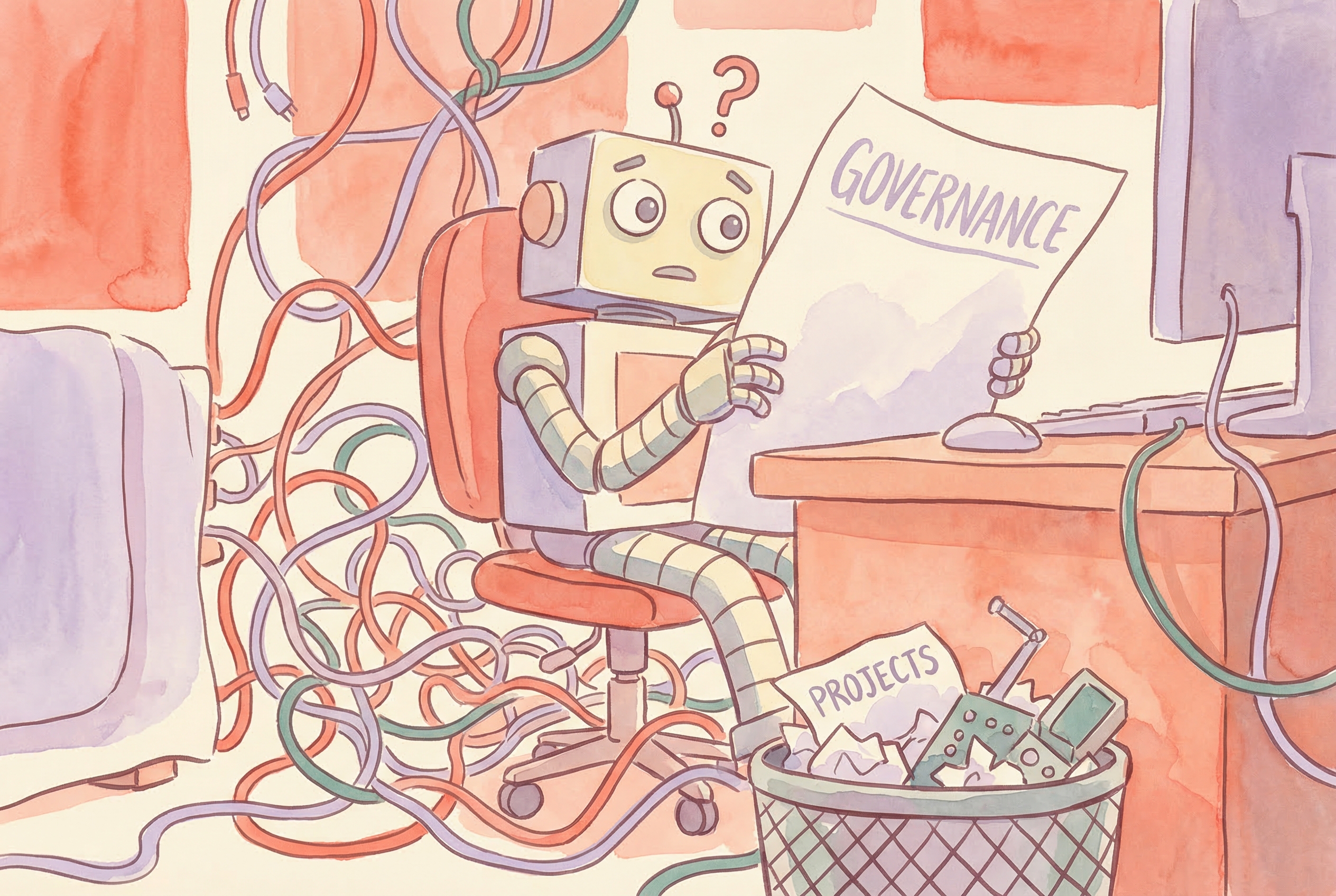
Gartner's latest forecast landed with a number that should be pinned to every AI project board in every enterprise: more than 40% of agentic AI projects started in 2025-2026 will be canceled or abandoned by the end of 2027. Not "underperform." Not "pivot." Canceled. Shut down. Written off.
The number is alarming but not surprising. Anyone who's watched the gap between AI agent demos and AI agent deployments has seen this coming. The demos are extraordinary. An agent that books travel, researches prospects, manages inventory, handles customer issues end-to-end, autonomously. The deployments are something else entirely. An agent that books the wrong flight, emails the wrong person, and creates a support ticket for a problem it caused.
The gap between these two realities is where 40% of projects go to die.
Why agents fail differently
Traditional software projects fail for traditional reasons: bad requirements, scope creep, budget overruns, technical debt. AI agent projects fail for all of those reasons plus a set of problems unique to autonomous systems.
| Failure Mode | Traditional Software | AI Agents |
|---|---|---|
| Scope creep | Requirements expand | Agent capabilities expand without matching guardrails |
| Integration complexity | API mismatches, data formats | Agent needs real-time access to systems it wasn't designed for |
| Testing | Deterministic, repeatable | Non-deterministic, different output each run |
| Error handling | Defined failure states | Novel failure modes that weren't anticipated |
| Security | Input validation, access control | Agent has system-level access, creates new attack surface |
| Accountability | Developer/team owns the bug | Nobody owns the agent's decision |
| Cost predictability | Fixed infrastructure costs | Inference costs scale with usage in unpredictable patterns |
The non-determinism problem is particularly insidious. When you test a traditional API, the same input produces the same output. When you test an agent, the same input can produce different actions depending on context, conversation history, model temperature, and the current state of every system the agent touches. Testing coverage for deterministic software is hard. Testing coverage for non-deterministic autonomous systems is a research problem masquerading as an engineering problem.
The three project killers
After looking at dozens of enterprise agent deployments, the failures cluster around three root causes.
1. No governance model
The most common failure mode is deploying an agent without defining who is responsible when it makes a mistake. This sounds like an organizational problem because it is. When an agent autonomously approves a purchase order, denies a customer claim, or sends an email to a client, and the outcome is wrong, the question "who approved this" has no clear answer.
| Decision Type | Without Governance | With Governance |
|---|---|---|
| Agent sends customer email | Agent decided, nobody reviewed | Business owner approved template and boundaries |
| Agent escalates support ticket | Agent's judgment, no criteria documented | Escalation rules defined, thresholds explicit |
| Agent accesses sensitive data | Agent has broad API access | Scoped permissions, audit trail, data classification |
| Agent makes purchasing decision | Agent authorized to spend, limits unclear | Spending authority defined, approval thresholds set |
Organizations that deploy agents without governance frameworks end up in one of two places. Either the agent does something wrong and there's a scramble to assign blame, or the agent is gradually restricted until it's functionally useless because nobody wants to be responsible for what it might do.
2. Infrastructure, not AI, is the blocker
The irony of most failed agent projects is that the AI component works fine. The agent can reason, plan, and generate appropriate actions. What fails is everything around it.
The agent needs clean API access to all relevant systems. Most enterprises don't have clean APIs. They have legacy systems with proprietary interfaces, undocumented endpoints, and inconsistent data formats. The agent needs real-time data. Most enterprises have batch-processed data that's hours or days stale. The agent needs an auditable monitoring layer. Most enterprises have log files that nobody reads.
The result is that "building an AI agent" is actually "modernizing your entire integration layer, building an observability stack, and creating a governance framework, and then putting an agent on top." The AI part is 20% of the work. The infrastructure is 80%. Budgets that account for only the 20% fail when the 80% shows up.
3. Unclear business value
This is the quiet killer. Many agent projects start with "we should have an AI agent for X" without a clear baseline of what success looks like. What does the agent replace? How much does that currently cost? What error rate is acceptable? What's the break-even point?
Without these answers, projects drift. The agent gets more capable but the business case never crystallizes. Twelve months in, a new CFO or a quarterly review asks "what's the ROI on this?" and nobody can answer. That's when projects get canceled. Not because the technology failed, but because nobody defined what success meant before building started.
What the surviving 60% do differently
The projects that survive share a recognizable pattern. They start narrow. Not "an agent that handles customer service" but "an agent that handles password reset requests for enterprise customers in the EMEA region." The scope is specific enough to define success criteria, test thoroughly, and assign accountability.
They build governance before capability. The questions of "what can this agent do" and "what is this agent not allowed to do" get answered at the same time, not in sequence.
They budget for the infrastructure. The integration work, the monitoring stack, the eval pipeline, and the human review processes are in the initial budget, not discovered as surprise costs at month six.
And they measure relentlessly. Not "the agent handled 500 tickets" but "the agent handled 500 tickets with a 94% resolution rate, a 3% escalation rate, and saved 120 hours of analyst time at a net cost savings of $47,000 per month." Specificity is what keeps the CFO from canceling the project.
The 2027 reckoning
Gartner's 40% number will play out over the next eighteen months. The projects launched in the agent gold rush of late 2025 and early 2026, the ones without governance frameworks, without infrastructure investment, without clear success metrics, will hit their first anniversary and face hard questions.
Some will be rescued by organizations that learn fast and course-correct. Most won't. The ones that fail will leave behind a residue of skepticism that makes the next generation of agent projects harder to fund, even when the technology is ready. That's the real cost of the 40%: not just the wasted investment, but the organizational scar tissue that makes future AI adoption slower and harder.
The technology works. The engineering challenges are solvable. The question was never whether AI agents can do useful things. The question is whether organizations can do the unglamorous work of governance, infrastructure, and measurement that turns a capable agent into a reliable system.
Forty percent of them can't. And the countdown is already running.
If you’re planning an AI agent, start by defining governance before you build: who owns outcomes, what decisions the agent can make, and what approvals, limits, and audit trails are required. Invest early in the unglamorous work—permissions, data access, integration reliability, and monitoring—because that’s where deployments usually break. Treat testing as continuous and probabilistic rather than one-and-done, and budget for variable usage-driven inference costs so the project doesn’t collapse when it scales.