- AI demos are often run in tightly controlled conditions that hide how systems behave with messy, real-world inputs.
- The gap between demo performance and production performance is large, with reported accuracy dropping from curated 95–99% to real-world 60–80%, making failures frequent and costly.
- Vendors optimize for polished demos because it sells, while buyers mistakenly treat demo results as representative of deployment reality.
- Enterprise AI commonly follows a funnel where pilots look successful but production and long-term value collapse due to scale, edge cases, drift, and ongoing oversight needs.
- When accuracy falls in production, the required human review can erase promised cost savings and introduce serious operational risk if errors are acted on.
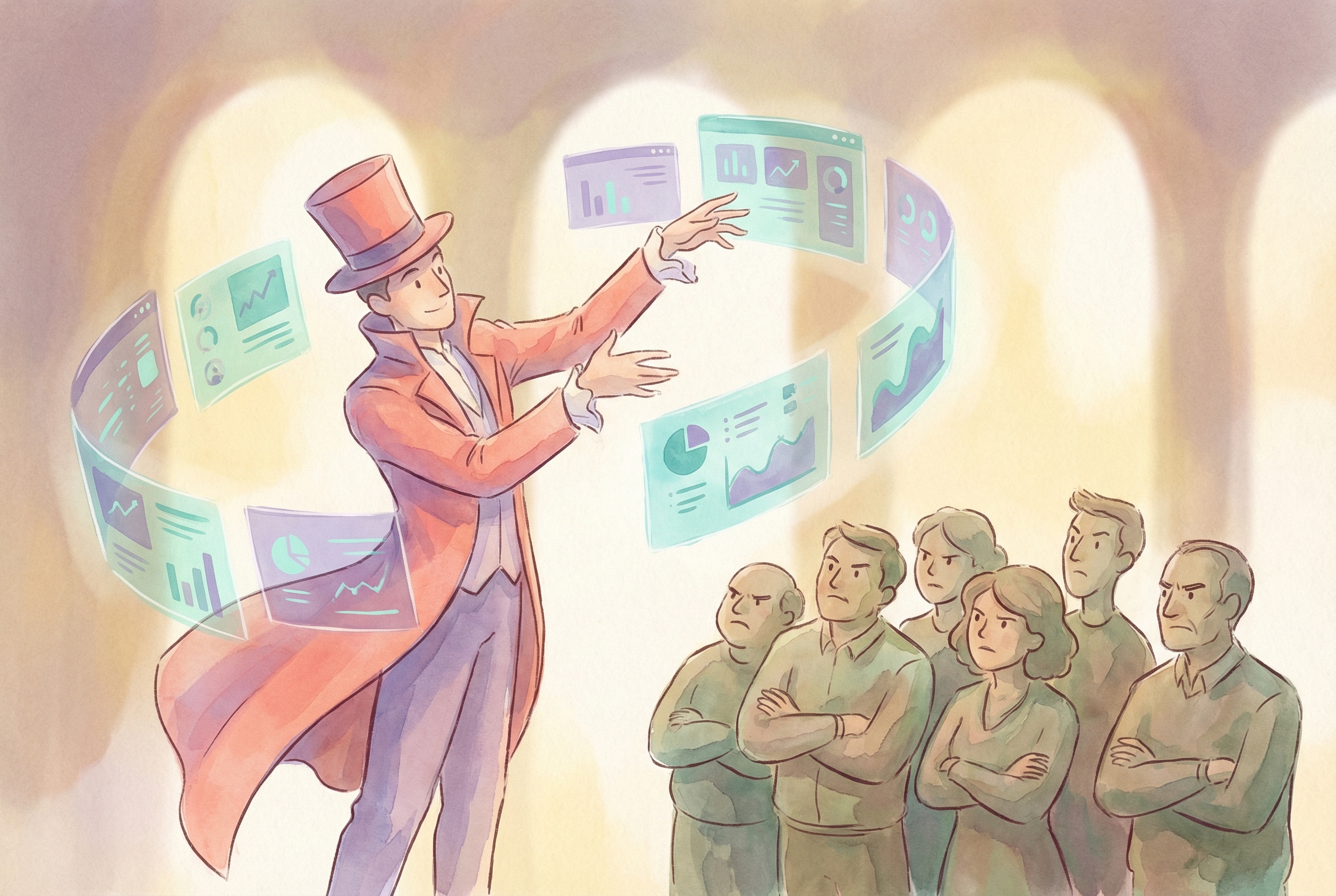
I watched a vendor demo last month where an AI agent parsed a 200-page contract, extracted every obligation clause, cross-referenced them against regulatory requirements, and produced a compliance summary, all in under 90 seconds. The room was impressed. The CTO was reaching for his wallet. I asked the vendor to run it again on a contract I'd brought. Different format, different jurisdiction, messier language. The agent choked. Not gracefully, not with a useful error message. It just produced confident nonsense that would have been dangerous if anyone had acted on it.
This is not an isolated experience. It is the norm. The gap between what AI looks like in a demo and what AI looks like in production has become one of the most expensive problems in enterprise technology, and almost nobody is talking about it honestly.
The demo industrial complex
AI vendors have gotten extraordinarily good at one thing: controlled demonstrations. The demo environment is carefully curated. The data is clean. The prompts are pre-tested. The use cases are cherry-picked to showcase the model's strengths while avoiding its weaknesses. Edge cases have been quietly removed. The lighting, metaphorically speaking, is always perfect.
This isn't necessarily malicious. Vendors genuinely believe in their products. But the incentive structure is broken. A demo that shows the product struggling with messy data doesn't close deals. A demo that shows confident, polished results does. So every vendor optimizes for the demo, and every buyer makes decisions based on a performance that has almost no relationship to what deployment will actually look like.
The numbers tell the story clearly:
| Metric | Demo environment | Production reality |
|---|---|---|
| Data quality | Clean, pre-formatted, curated | Messy, inconsistent, multi-format |
| Task complexity | Single-step, well-defined | Multi-step, ambiguous, context-dependent |
| Error handling | Errors removed from demo flow | Errors are the majority of edge cases |
| Latency | Optimized infrastructure, small dataset | Real infrastructure, real data volumes |
| Accuracy reported | 95-99% (on selected examples) | 60-80% (on real-world distribution) |
| Human oversight | None shown, none needed | Constant, expensive, essential |
That accuracy gap is where the real money disappears. A system that works 97% of the time on curated demo data and 72% of the time on your actual data is not a system that's "almost there." It's a system that fails more than one in four times, and in most enterprise contexts, that failure rate is unacceptable without heavy human review, which eliminates most of the cost savings the vendor promised.
Why pilots succeed and deployments fail
There is a well-documented pattern in enterprise AI: the pilot works, the deployment doesn't. Organizations run a proof of concept on a small, controlled dataset with their best people paying close attention. It looks great. They greenlight the full rollout. Then reality hits.
The pilot-to-production failure rate across the industry is staggering:
| Stage | Estimated success rate | What happens |
|---|---|---|
| Vendor demo | ~100% (by design) | Curated data, pre-tested prompts, ideal conditions |
| Internal pilot | ~60-70% | Controlled data, dedicated team, high attention |
| Production deployment | ~20-30% | Real data, real users, real edge cases, real scale |
| Sustained production (12+ months) | ~10-15% | Drift, data changes, staff turnover, maintenance costs |
These numbers are approximate, drawn from industry reports and my own experience across dozens of enterprise AI projects, but the shape of the funnel is consistent everywhere I look. The majority of AI initiatives that clear the pilot stage never deliver sustained production value.
The reasons are predictable and largely the same every time. The pilot data was cleaner than the production data. The pilot team gave the system more attention than any production team can sustain. The pilot scope was narrower than the real workflow. And the pilot timeline was too short to reveal drift, where model performance degrades over time as the world changes around it.
The vocabulary of misdirection
Part of the problem is language. Vendors have developed a vocabulary that sounds precise but is actually designed to obscure. When you hear these phrases in a demo, your skepticism should increase, not decrease.
"State of the art accuracy" means "the best we've measured on our benchmark," which may have nothing to do with your data. "Enterprise-ready" means "we have SSO and an admin panel," not "this will work reliably at scale in your environment." "Human-in-the-loop" is presented as a feature when it's actually an admission that the system can't be trusted to work on its own. "Fine-tuned for your industry" usually means they ran it on a few dozen examples from your sector, not that it deeply understands your domain.
None of this is technically false. All of it is misleading. And the cumulative effect is that procurement teams make decisions based on a carefully constructed impression rather than an honest assessment of capability.
What to actually look for
After sitting through more AI demos than I can count, and after watching the aftermath when organizations buy what the demo sold them, I've developed a set of evaluation criteria that cuts through the performance.
| Evaluation check | What to ask | Red flag |
|---|---|---|
| Run it on your data | "Can we test this on our actual data, right now?" | Vendor wants to "prepare" or needs data in a specific format first |
| Failure mode demonstration | "Show me what happens when it gets something wrong" | Vendor only shows success cases, avoids or deflects |
| Accuracy on edge cases | "What's the accuracy on messy, incomplete, or contradictory inputs?" | Only quotes accuracy on clean benchmark data |
| Total cost of ownership | "What does the human review workflow cost us?" | Only discusses license cost, ignores operational overhead |
| Production references | "Can we speak to a customer running this in production, not a pilot?" | Only offers pilot references or case studies without specifics |
| Drift monitoring | "How do we know when performance degrades over time?" | No built-in monitoring, relies on users to notice problems |
| Data requirements | "What data preparation do we need to do before this works?" | Glosses over data quality requirements or assumes clean data |
The most important question on that list is the first one. Any vendor that won't run their product on your actual data, in real time, during the evaluation, is telling you something important. They're telling you their product works on their data, and they're not confident it will work on yours.
The cost of the confidence gap
The real damage from misleading demos isn't just wasted license fees. It's the organizational cost of misplaced confidence.
When leadership greenlights an AI initiative based on a compelling demo, they set expectations across the organization. Headcount plans change. Process redesigns begin. Teams start preparing for a new way of working. When the production deployment underperforms, you don't just lose the technology investment. You lose organizational trust, executive credibility, and, most critically, the willingness to try again.
I've watched companies abandon genuinely promising AI use cases, not because the technology wasn't ready, but because a previous failed deployment created so much institutional skepticism that nobody would sponsor the next attempt. The bad demo didn't just waste money. It poisoned the well for everything that came after.
The vendor's responsibility and yours
I am not arguing that AI doesn't work. It does. There are real, measurable, transformative applications of AI in enterprise workflows right now. Contract analysis, code generation, data transformation, customer communication, content production, these are areas where AI delivers genuine value every day.
But that value only materializes when organizations buy with clear eyes. When they insist on testing with their own data. When they budget for the human oversight the vendor didn't mention. When they plan for the integration complexity that wasn't part of the demo. When they set expectations based on realistic performance, not the highlight reel.
Vendors have a responsibility to demo honestly, but let's be realistic about incentive structures. They won't. The pressure to close deals will always push demos toward the optimistic end of the spectrum. That means the responsibility falls on buyers to be rigorous, skeptical, and insistent on evidence that goes beyond the controlled demonstration.
The question that changes everything
Next time you sit through an AI demo and feel that rush of excitement, that sense that this could change everything, pause. Ask yourself one question: what would this look like on my worst data, on a Tuesday afternoon, run by my most junior team member, with no vendor support on the line?
If you can't answer that question, you haven't evaluated the product. You've watched a show. And the difference between those two things is, conservatively, about six figures and twelve months of your organization's time.
Treat every demo as a best-case scenario and insist on testing the system against your own messy, representative data before making a decision. Ask vendors to show how the product fails, what uncertainty looks like, and what the human review workflow and ongoing maintenance costs are in real deployments. Plan for production realities—data variability, edge cases, monitoring, and model drift—so you don’t confuse a successful pilot with sustained value.