- AI data centers are rapidly absorbing global memory output, with projections that they’ll consume about 70% of the world’s memory chips by 2026.
- Because fabs are maxed out and take years and tens of billions to expand, every wafer shifted to high-margin HBM for AI is a wafer taken away from consumer RAM and SSD supply.
- HBM demand is exploding (from ~8% of DRAM production in 2024 to 25%+ by 2026), pushing sharp price increases across DRAM categories and spilling over into consumer devices.
- The PC market is getting hit at the worst time: Windows 10 end-of-life and “AI PC” RAM requirements are colliding with rising memory costs, leading to fewer units sold but higher prices per machine.
- Smaller buyers are especially exposed as spot markets become volatile enough for “hourly pricing,” while hyperscalers with long-term contracts are insulated.
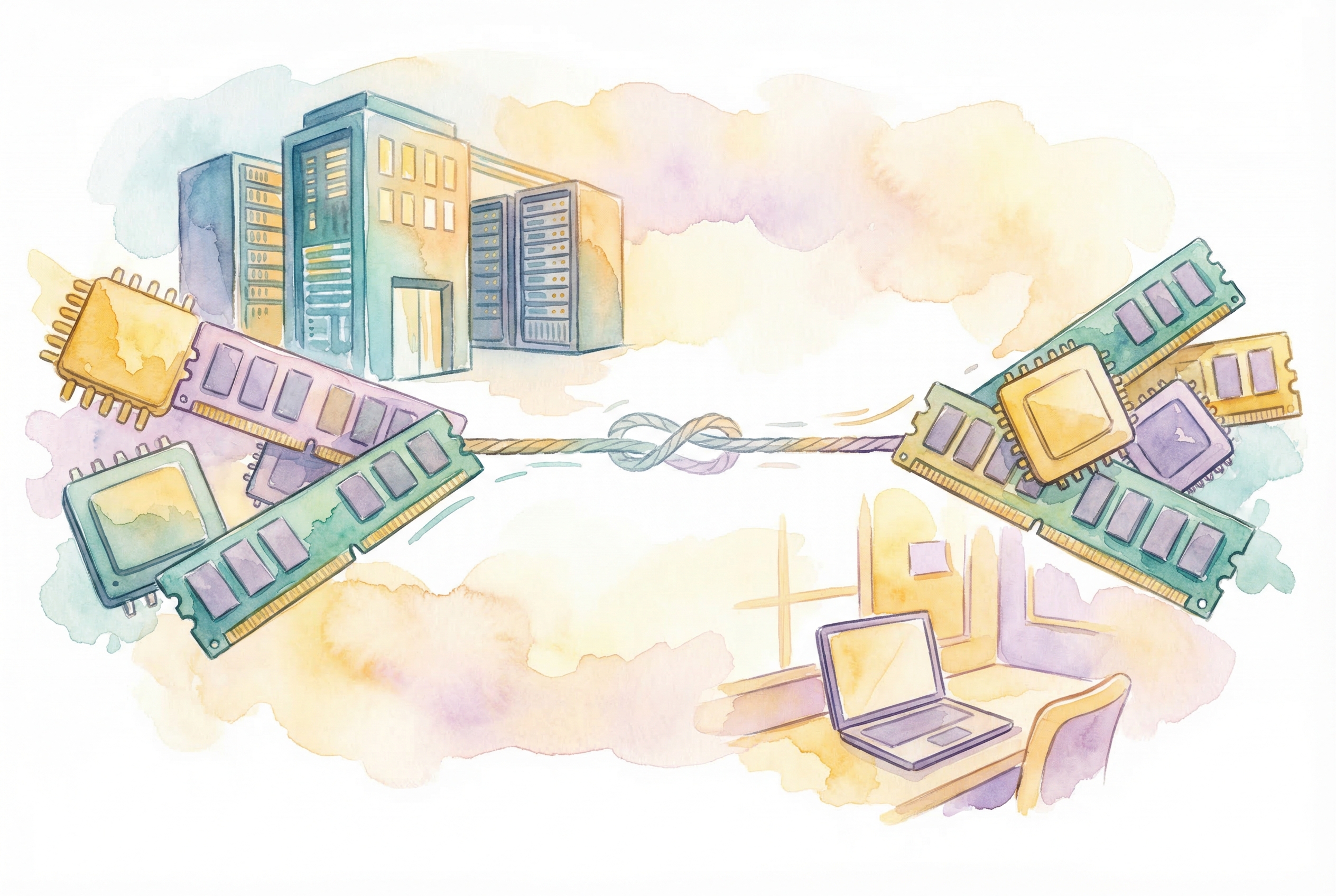
Somewhere in a Samsung fabrication facility, a choice is being made. The same cleanroom, the same silicon wafers, the same production line, but the output has shifted. Instead of the LPDDR5X module destined for your next laptop, the wafer is being carved into HBM3E stacks for NVIDIA's next GPU shipment to a hyperscaler data center. Your laptop gets more expensive. The data center gets fed. This is the memory war, and consumers are losing.
The numbers are stark. Data centers will consume 70% of the world's memory chip production in 2026. DRAM prices have surged 80-90% in a single quarter. PC vendors are warning clients of 15-20% price hikes with more coming. And the three companies that control global memory production, Samsung, SK Hynix, and Micron, are making a rational economic choice: every wafer allocated to high-margin HBM for AI is a wafer denied to consumer devices.
The zero-sum wafer
Memory manufacturing isn't like software. You can't spin up another instance. Fabrication plants cost $15-20 billion to build and take three to four years to become operational. Production capacity in 2026 was determined by investment decisions made in 2022 and 2023, when nobody fully anticipated how aggressively hyperscalers would consume HBM.
| Memory Type | Primary Consumer | 2024 Demand | 2026 Demand | Price Change |
|---|---|---|---|---|
| HBM3/HBM3E | AI GPUs (data centers) | 8% of DRAM production | 25%+ of DRAM production | +200% (contract pricing) |
| Server DDR5 | Cloud & enterprise | 32% of DRAM production | 35% of DRAM production | +60-80% |
| LPDDR5X | Smartphones, laptops | 35% of DRAM production | 22% of DRAM production | +80-90% |
| Consumer DDR5 | Desktop PCs | 15% of DRAM production | 10% of DRAM production | +60-70% |
| 3D NAND | SSDs, storage | Separate fabs | Shared equipment being reallocated | +40-50% |
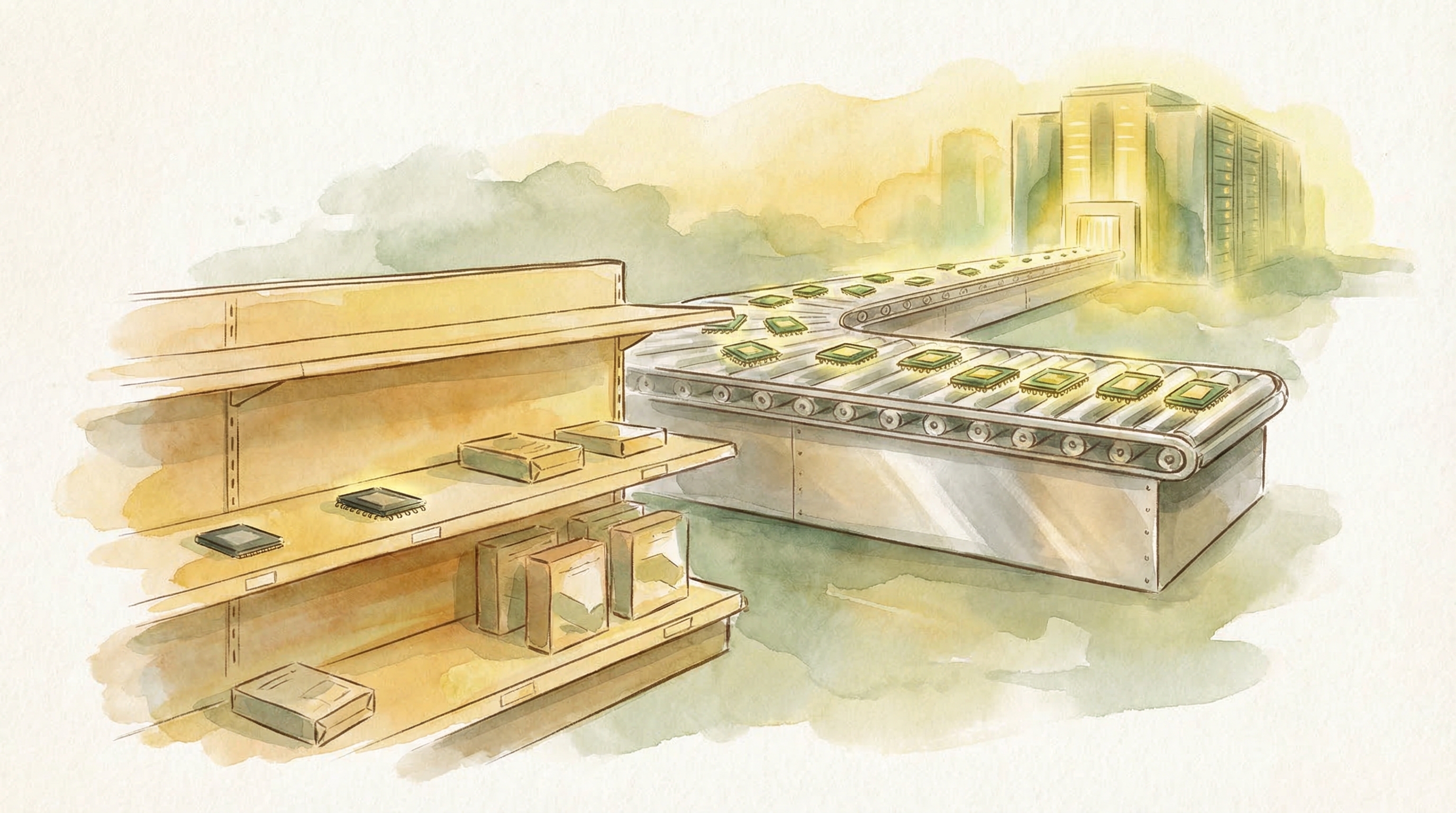
The reallocation is a zero-sum game. Samsung, SK Hynix, and Micron aren't sitting on idle capacity. They're running at maximum utilization. The only question is what gets made with that capacity, and the answer is whatever pays the highest margin. Right now, that's HBM for AI infrastructure, by a wide margin.
The ripple effects
This isn't an abstract supply-chain story. It's hitting real products, real prices, and real people.
The PC perfect storm
The timing could not be worse for the PC industry. Microsoft's Windows 10 end-of-life deadline is driving a massive hardware refresh cycle, exactly when memory prices make new PCs significantly more expensive. The "AI PC" marketing push requires 16-32GB minimum RAM, at precisely the moment when RAM costs more than it has in years.
IDC has slashed its 2026 PC shipment forecast, but projects total market value will still increase to $274 billion because the price per unit is climbing fast enough to offset lower volumes. Translation: fewer people buying PCs, everyone paying more.
Smartphones feel the squeeze
Flagship phones that shipped with 12GB of RAM at $999 in 2024 are now specced with the same memory at $1,199. Some manufacturers are quietly dropping RAM configurations, offering 8GB where 12GB was standard, because the cost delta has become unacceptable.
The hourly pricing dystopia
Perhaps the most telling indicator of how severe this shortage has become: Tom's Hardware reported that DRAM is now subject to "hourly pricing" in spot markets. Small and medium businesses that can't lock in long-term contracts are bidding against each other for scraps, watching prices fluctuate in real-time like a commodities trading floor. The stable, predictable pricing that made hardware budgeting possible is gone.
Who wins and who loses
The distribution of pain is predictable. Big tech companies locked in multi-year supply agreements before the shortage peaked. Everyone else is scrambling.
| Player | Position | Why |
|---|---|---|
| NVIDIA | Massive winner | Sells GPUs at premium prices, memory shortage limits competition |
| Samsung/SK Hynix/Micron | Winners | Higher margins on HBM vs consumer DRAM |
| Microsoft/Google/Meta/Amazon | Buffered | Long-term supply contracts, massive purchasing power |
| Large PC OEMs (Dell, HP, Lenovo) | Stressed | Passing costs to consumers, lower volume forecasts |
| Small/mid hardware makers | Squeezed | Spot-market pricing, unpredictable costs |
| Consumers | Losing | Higher prices, lower specs, delayed upgrades |
| Enterprise IT buyers | Losing | Budget overruns, delayed refresh cycles |
When does it end?
The honest answer is: not soon. New fabrication capacity won't materially impact global supply until 2028. Samsung's new facility in Taylor, Texas and SK Hynix's expansion in Indiana are underway, but semiconductor fabs don't produce chips overnight.
Meanwhile, AI demand shows no signs of slowing. Every new model release, every agent framework, every enterprise deployment adds pressure. The appetite for HBM will grow as models get larger and inference demands scale. Even if total memory production increases 20% year-over-year, it won't outpace the growth in AI infrastructure spending.
The uncomfortable math
Here's what nobody in the AI industry wants to talk about: the infrastructure buildout powering the AI revolution is being subsidized, in part, by making every other computing device more expensive. The consumer paying $300 extra for a laptop isn't funding AI research directly. But the manufacturer choosing to allocate wafers to AI chips instead of consumer DRAM is making that exact tradeoff on the consumer's behalf.
This is the hidden tax of the AI boom. Not a line item on your receipt, not a policy anyone voted for, but a market dynamic where the promise of AI-driven revenue for chip manufacturers makes consumer computing a lower priority.
The memory war has a winner, and it's the data center. Everyone else is paying for it, one overpriced RAM stick at a time.
If you’re planning a PC, laptop, or phone upgrade, expect memory-heavy configurations to cost more and consider buying sooner rather than later if you find a good price. When comparing devices, pay close attention to RAM and storage tiers—some brands may quietly downgrade base specs to manage costs. If you run a small business, try to lock in longer-term purchasing or pre-order windows where possible, because spot pricing volatility can make budgeting unpredictable. Watch for signs of capacity expansion or easing HBM demand, since that’s what will ultimately determine when consumer memory prices cool off.