- GPT-5.4’s headline upgrade is native computer use, letting the model directly operate the OS (click, type, navigate) as a built-in capability rather than a plugin.
- OpenAI shipped three configurations—Standard, Thinking, and Pro—reflecting different compute/latency needs instead of forcing one model to fit every workload.
- A million-token context window is now standard across all GPT-5.4 variants, matching Claude and shifting competition from context length to how well models use long context.
- GPT-5.4 reports meaningful real-world quality gains, cutting individual claim errors by 33% and full-response errors by 18% versus GPT-5.2.
- Native computer use aims to reduce translation friction between reasoning and UI actions, potentially making multi-step automation more reliable in production.
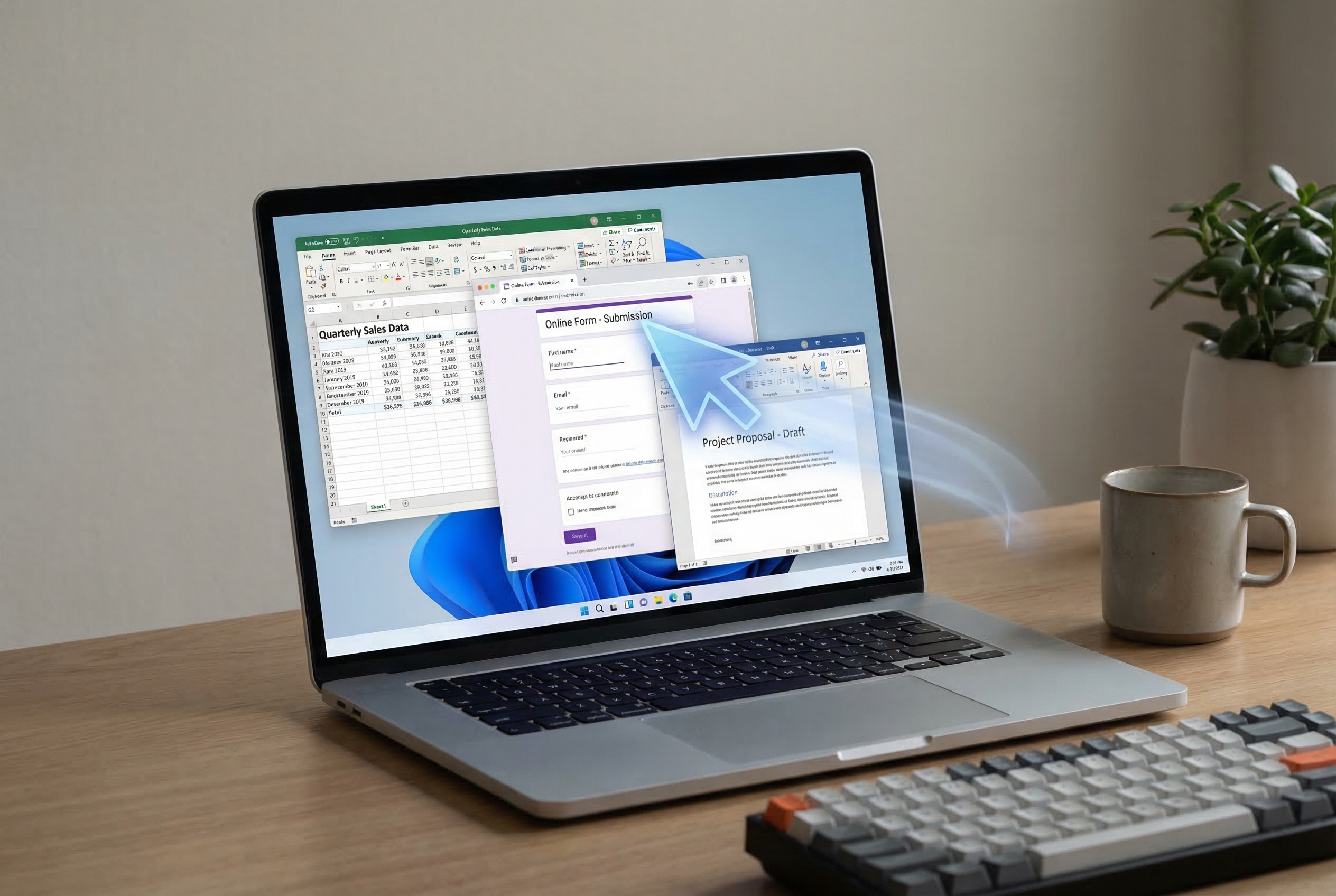
OpenAI released GPT-5.4 on March 5, and the headline feature wasn't another benchmark improvement. It was native computer use, the ability for the model to directly interact with your operating system, click buttons, fill forms, navigate applications. Built into the model, not bolted on as a plugin.
The release came in three variants: Standard, Thinking (reasoning-first), and Pro (maximum capability). The million-token context window, previously available only from Anthropic's Claude, is now standard across all three.
On the accuracy front, GPT-5.4 reduces individual claim errors by 33% and full-response errors by 18% compared to GPT-5.2. Those numbers matter more than most benchmark improvements because they measure something users actually experience: how often the model says something wrong.
Computer use changes the conversation
Anthropic introduced computer use with Claude in late 2024, and it worked, mostly. The gap between "works in demos" and "works in production" was significant enough that few organizations deployed it at scale. OpenAI building computer use natively into GPT-5.4, rather than offering it as a separate tool, is a bet that the capability needs to be a first-class citizen of the model architecture.
The difference between native and bolt-on computer use matters in practice. When computer use is a separate layer, the model reasons about the task and then translates its reasoning into UI actions, two steps with a lossy interface between them. When it's native, the model reasons about the task and the UI simultaneously. Fewer translation errors, faster execution, more reliable multi-step workflows.
Three variants is an architecture decision
The three-variant release is worth examining. Standard is the general-purpose model. Thinking adds explicit reasoning chains before generating output, essentially the model showing its work. Pro maximizes capability at higher compute cost.
This is OpenAI acknowledging that different tasks have different computational profiles. A customer service chatbot doesn't need reasoning chains. A code review does. A data analysis pipeline needs maximum capability. Rather than forcing users to tune a single model's behavior through prompting, they're shipping purpose-built configurations.
| Variant | Best For | Trade-off |
|---|---|---|
| Standard | General tasks, speed-sensitive workflows | Less reliable on complex reasoning |
| Thinking | Code, analysis, multi-step problems | Slower, higher token usage |
| Pro | Maximum accuracy, critical decisions | Highest cost per query |
The million-token race is over
With GPT-5.4 matching Claude's million-token context window, the context length competition is effectively settled. Both major providers now offer enough context to ingest entire codebases, full legal contracts, or months of conversation history in a single prompt.
The question shifts from "how much can the model hold" to "how effectively does it use what it holds." A million tokens of context is useless if the model can't reliably reference information from the middle of that window. Early reports suggest GPT-5.4 handles mid-context retrieval better than its predecessors, but the real test will be production workloads over the coming weeks.
What to watch
The native computer use capability is the story to track. If it proves reliable enough for enterprise workflows, automated testing, form processing, cross-application data entry, it unlocks a category of AI automation that previous approaches couldn't reach. Not because the idea is new, but because the execution might finally be good enough.
The error reduction numbers are the other signal. A 33% reduction in factual errors sounds incremental until you calculate what it means at scale: millions fewer wrong answers per day across ChatGPT's user base. For organizations building production systems on top of GPT, that's the difference between "useful with human oversight" and "useful with spot-checking."
If you’re evaluating GPT-5.4, focus your testing on whether native computer use is reliable enough for your real workflows—things like form processing, cross-app data entry, and automated QA—since that’s where the biggest step-change could be. Pick the variant that matches your needs: Standard for speed, Thinking for analysis-heavy tasks like code review, and Pro when accuracy matters more than cost. And if you plan to use the million-token window, stress-test mid-context retrieval and long-document referencing, because the value comes from how consistently the model can pull the right details from deep in the prompt.