- Google’s reported $40B investment in Anthropic signals a shift from “hedge” to primary strategic bet, implying Google sees something it can’t match quickly with Gemini alone.
- The prior “triangle” of clear lab–cloud alignments is dissolving as OpenAI and Microsoft revise their partnership, ending Azure exclusivity and changing competitive moats.
- A key implied driver is enterprise reality: Claude is portrayed as more reliable than Gemini in instruction-following, tool use, and agentic workflows that matter in production.
- OpenAI’s ability to run on any cloud reshapes leverage across the market, forcing Google to both compete with OpenAI on Google Cloud and back Anthropic at the same time.
- For enterprises, the net effect is more choice and pricing leverage, but also more platform uncertainty as previously stable assumptions about access and deployment shift.
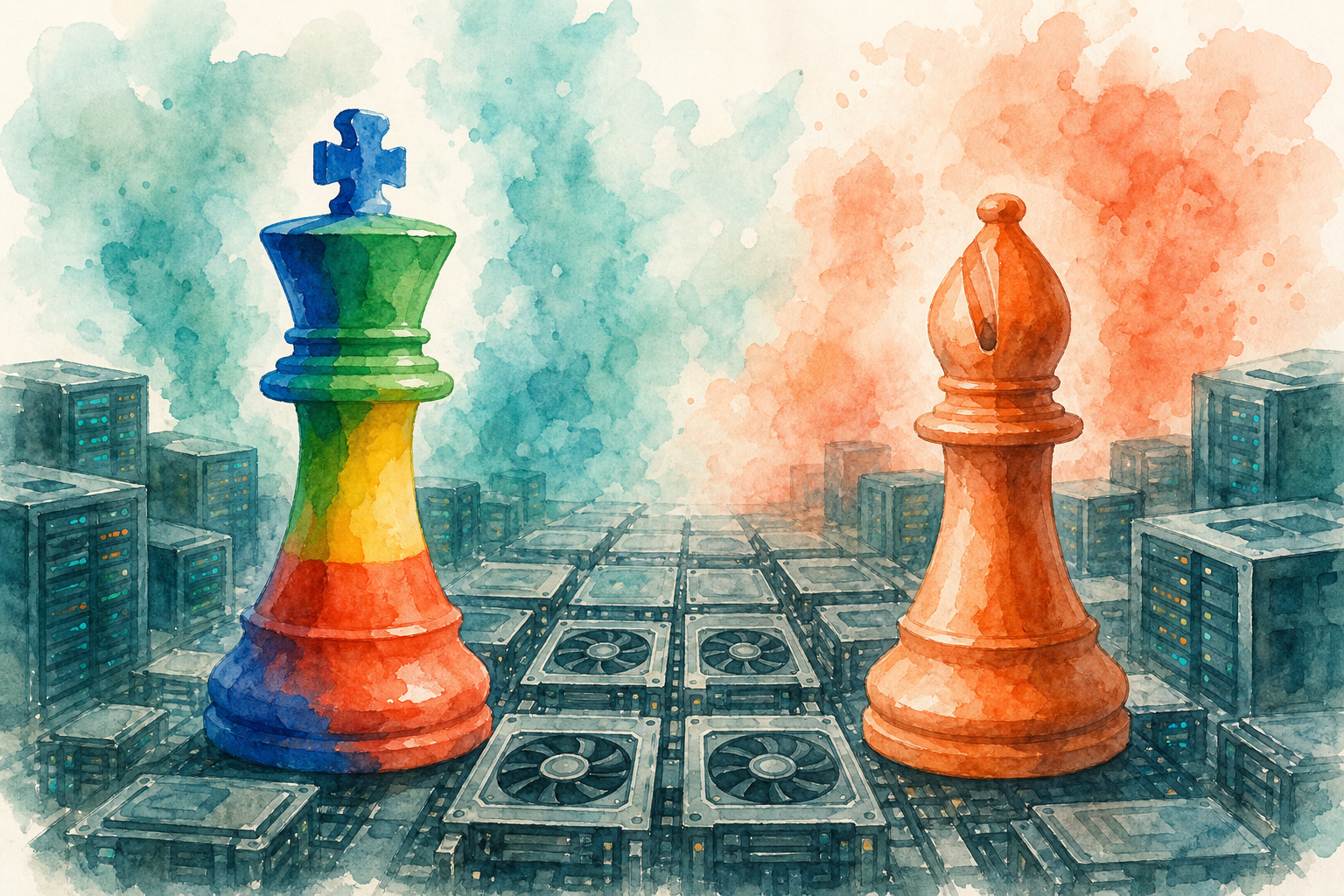
Google has DeepMind. Google has Gemini. Google has more AI PhDs than any other company on earth. Google has TPU hardware, the largest training clusters, and direct control over the data that trains half the internet's AI models.
Google just invested $40 billion in Anthropic. The largest single AI investment in history.
When the company with the most resources bets that much on someone else's model, the question isn't about Anthropic's valuation. The question is what Google sees that makes their own capabilities insufficient.
The competitive triangle is breaking
Three things happened in quick succession that reshaped the competitive landscape. Google made the $40 billion Anthropic investment. OpenAI and Microsoft amended their partnership, ending Azure exclusivity and the revenue share arrangement. And OpenAI began raising its own massive round while restructuring as a for-profit entity.
The old structure was straightforward: Microsoft owned a piece of OpenAI and got Azure exclusivity. Google invested in Anthropic as a strategic hedge. Each major lab had a clear cloud partner and a clear competitive position. OpenAI had the consumer brand, Google had the infrastructure, Anthropic had the safety research and increasingly strong enterprise traction.
That structure is dissolving. Microsoft no longer has exclusive deployment rights for OpenAI models. OpenAI can ship on any cloud, which means they can deploy on Google Cloud and AWS. Google's position on Anthropic just went from hedge to primary bet. Not a side investment. $40 billion.
What Google sees
There are two ways to read this investment.
The generous interpretation: Google believes the AI market is large enough that backing multiple approaches is rational portfolio management. $40 billion is significant, but Google's market cap absorbs it. They're not abandoning Gemini. They're ensuring they have a position regardless of which approach wins.
The less comfortable interpretation: Google's internal teams, despite having every structural advantage, haven't produced a model that consistently beats Claude on the use cases that matter most for enterprise adoption. Gemini is competitive on benchmarks. It's good on multimodal tasks. But Anthropic's approach to instruction-following, tool use, and agentic work has pulled ahead in the workflows enterprises are actually building on. The feedback from organizations deploying both is consistent: Claude follows complex instructions more reliably than Gemini in production settings.
Google doesn't write a $40 billion check for something they can do themselves. They write it for something they can't replicate, or can't replicate fast enough.
The Microsoft angle
The OpenAI-Microsoft partnership amendment changes the dynamics for everyone. Microsoft gave up Azure exclusivity. That means OpenAI models can now run on Google Cloud, on AWS, on any infrastructure.
This is bad for Microsoft's competitive moat, good for OpenAI's leverage, and complicated for Google. Google now competes with OpenAI on its own cloud infrastructure while simultaneously backing Anthropic. Three major players, all simultaneously competing with and investing in each other. None confident enough in their own position to go it alone.
For enterprises, the practical effect is more choice and more instability. The provider relationships that seemed locked in a year ago are all in motion. If you built your stack around Azure-exclusive OpenAI access, that assumption just changed. If you assumed Google Cloud meant Gemini only, that's changing too. The platform lock-in that used to simplify decisions is evaporating.
What it means for your stack
If you're an enterprise making AI platform decisions, the instability cuts both ways. On one hand, more competition and more deployment flexibility means better pricing and more options. On the other hand, the partnerships you built your architecture around are shifting under your feet.
The safe bet used to be picking the cloud provider and getting their AI partner included. Azure meant OpenAI. Google Cloud meant Gemini. AWS meant Anthropic (through their own investment). Those clean pairings are breaking. Every cloud will offer every major model. The differentiation moves from "which cloud are you on" to "which model actually works for your use case," which is a harder question but a better one.
The real signal
The $40 billion number is less interesting than what it reveals about the state of the race. Google has everything you'd need to win on paper: the talent, the compute, the data, the distribution, the research depth. They still wrote a check for $40 billion to a company with a fraction of their resources, because the race isn't won by resources alone.
The differentiation lives in model architecture, training methodology, and the product decisions that determine whether an AI system does what you actually need it to do in practice. On that dimension, Google apparently believes Anthropic has something worth $40 billion that Google's 200,000 employees and unlimited compute budget can't replicate fast enough internally.
That's the signal. Not the dollar amount. The admission embedded in the dollar amount. The company that should, by every traditional measure, be winning this race is placing the largest bet in AI history on someone else winning it instead.
When the company with the most resources is betting on someone else's model, the rest of us should pay attention to why.
Treat your AI stack as multi-provider by default: design for portability across clouds and model vendors so a partnership change doesn’t force a rewrite. Re-evaluate any architecture decisions that assumed Azure-exclusive OpenAI access or a single-model Google Cloud strategy, and negotiate contracts with exit clauses and flexibility. In pilots, prioritize production-grade criteria—instruction reliability, tool/agent behavior, and operational fit—over benchmark scores, and keep a close watch on how Google–Anthropic and OpenAI’s cloud deployments evolve.