- ChatGPT began serving ads embedded directly inside conversational answers, turning recommendations into potential marketing placements.
- Soaring compute costs and limited subscription/API revenue make advertising an attractive (and historically common) path for consumer tech platforms.
- Once ads are part of the model’s incentives, “best tool” recommendations can be commercially influenced, meaning users can’t assume neutrality by default.
- Enterprise teams using ChatGPT for research or vendor evaluation now need to treat outputs as potentially biased and adjust their decision processes accordingly.
- This shift creates room for competitors to differentiate on “no-ads” trust, likely splitting the market into ad-supported consumer AI and paid professional AI.
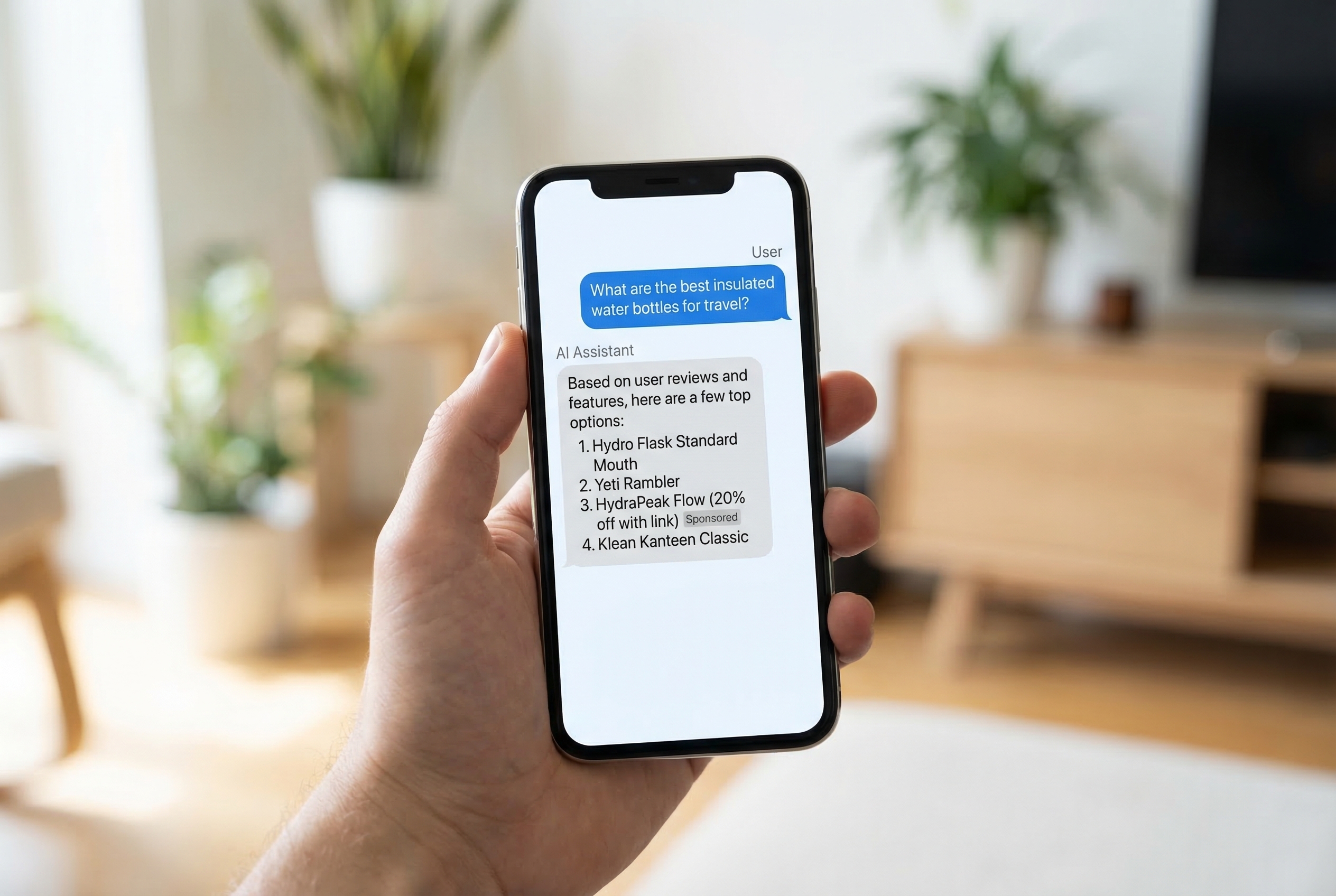
In the first week of March 2026, ChatGPT began serving advertisements to users. Not banner ads in the sidebar. Not sponsored links below the chat. Actual ads integrated into conversational responses, the AI recommending products and services as part of its answers.
If you're a digital marketer, this should have made you stop scrolling. If you're an AI user, it should make you reconsider what "helpful" means when the definition is being shaped by advertising revenue.
The business model problem
OpenAI's cost structure has always been the elephant in the room. Running GPT-5.4 at scale, with native computer use and million-token context windows, costs substantially more per query than previous models. The company reportedly burns through billions annually on compute alone.
ChatGPT Pro subscriptions at $200/month and API revenue cover a fraction of this. The math has always pointed toward either raising prices dramatically or finding alternative revenue streams. Advertising is the alternative revenue stream that every consumer tech company eventually discovers.
The precedent is familiar. Google started as a search engine that returned organic results. Then it added "sponsored" results at the top. Then the sponsored results became increasingly difficult to distinguish from organic ones. Facebook started as a social network. Then it became an advertising platform with social features attached.
ChatGPT is walking the same path: an AI assistant that started as a tool for users, gradually becoming a tool for advertisers.
What changes
When an AI assistant has no advertising incentive, its recommendation for "best project management tool" is based on whatever its training data suggests is actually the best tool. When that same assistant has advertising relationships, its recommendation is influenced by who's paying.
This isn't speculation about a slippery slope. It's how advertising-supported technology always works. The product isn't the software. The product is the user's attention, and the customer is the advertiser.
For enterprise users, the implications are direct. If your team uses ChatGPT for research, vendor evaluation, or technology recommendations, you now need to account for the possibility that the model's suggestions are commercially influenced. That doesn't mean every recommendation is an ad, but it means you can no longer assume none of them are.
The competitive angle
This creates an opening for competitors who can credibly claim their models have no advertising incentive. Anthropic charges directly through API usage, no ads. Google's Gemini is backed by a company that already has an advertising business, which cuts both ways, it has the infrastructure but also the incentive.
The market may split along this line: advertising-supported AI for consumers, subscription or API-supported AI for professionals. The same split that happened in media (free ad-supported news vs. paid subscriptions) and in streaming (free tier with ads vs. premium tier without).
For users who care about the neutrality of their AI's recommendations, the question becomes: which providers can you trust to keep advertising out of the conversation? And are you willing to pay more for that guarantee?
The bigger picture
ChatGPT running ads isn't just a business model change. It's the moment when AI assistants stopped being purely tools and became media channels. A media channel is a platform where someone pays to influence what you see. That's what ChatGPT is now.
The transition happened faster than most expected. It took Google a decade to go from "don't be evil" to "sponsored results everywhere." It took social media companies about five years. ChatGPT went from launch to ads in roughly three years.
Every AI company will face this decision eventually. The compute costs of frontier models create enormous pressure toward advertising revenue. The question for the industry isn't whether more AI companies will run ads. It's whether any of them can build a sustainable business without doing so.
If you use ChatGPT to choose tools, vendors, or strategies, start treating its recommendations like you would search results on an ad-driven platform: useful, but not automatically neutral. Ask for multiple options with explicit pros/cons, request sources, and cross-check shortlists with independent reviews or internal trials. If neutrality matters, consider whether a paid, no-ads model (or an enterprise plan with clear guarantees) is worth the cost for your team.