- AI’s direct water use is tiny compared with everyday goods and activities: a pair of jeans or a smartphone embodies millions of ChatGPT prompts’ worth of water, and one day of an average American’s water footprint equals roughly 800,000 prompts.
- Across all American data centers, AI accounts for about 0.008% of U.S. freshwater use, and even with 10x growth by 2030 it would be around 0.08%—still small relative to other uses like golf courses.
- Google’s disclosures suggest a typical AI prompt uses about 2 milliliters of water, making heavy personal use (e.g., 10,000 prompts/year) negligible compared with an individual’s total annual water footprint.
- Many alarming headlines inflate AI’s “water use” by mixing non-consumptive power-plant withdrawals with consumptive electricity-generation losses and the much smaller on-site data-center water use, then presenting big absolute numbers without context.
- Common media tactics include comparing to households instead of industries, using worst-case assumptions, citing permit maximums as actual use, and omitting percentages that show the impact is marginal.
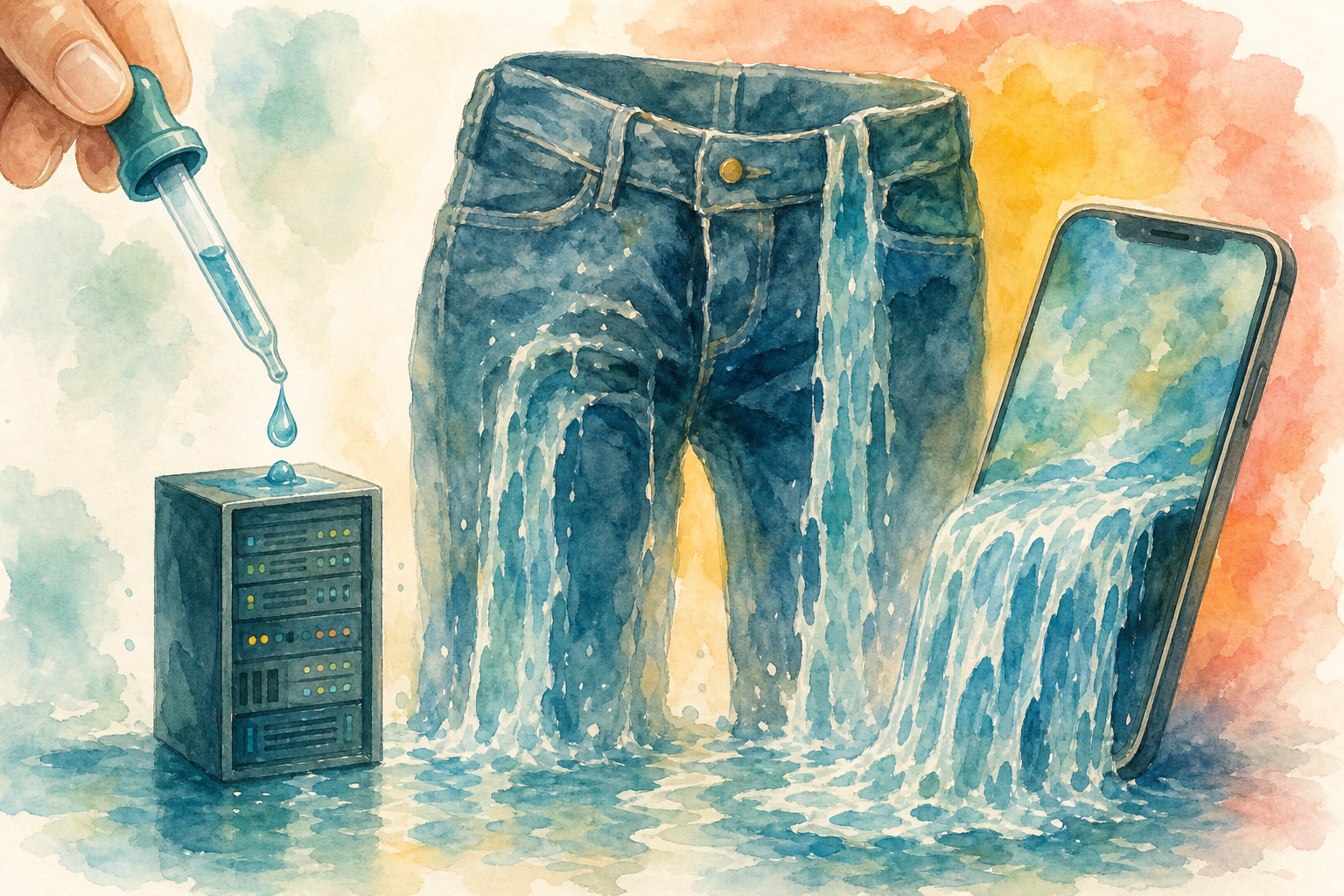
Manufacturing a single pair of jeans consumes the same amount of water as 5.4 million ChatGPT prompts. A smartphone costs 6.4 million prompts' worth. Playing a PS5 for one hour uses as much water, through electricity generation, as 200 prompts. The numbers aren't close. AI's water footprint is so small relative to everything else in your life that worrying about it is like using an eyedropper to save water from a pot you're boiling.
Every major headline about AI and water in the past two years has been misleading in specific, verifiable ways. Andy Masley, an independent researcher who has been systematically debunking AI water claims since 2024, published the most comprehensive analysis of this issue. What follows draws heavily on his work, cross-referenced with USGS data, Lawrence Berkeley National Lab reports, and Google's sustainability disclosures.
The real numbers
All AI in all American data centers combined uses 0.008% of the country's freshwater. That's the water footprint of 25,000 people in a nation of 340 million.
Google's own sustainability data estimates each AI prompt uses about 2 milliliters of water. The average American's total daily water footprint is about 1,600 liters, mostly food production, manufacturing, and electricity. One day of your normal life uses the same water as 800,000 chatbot prompts. If you sent 10,000 prompts per year, the water consumed adds up to 1/300,000th of your total annual water footprint.
Even with aggressive 10x growth by 2030, AI would reach 0.08%, about 5% of the water Americans use on golf courses. In Maricopa County, Arizona, one of the most water-stressed regions in the country, data centers use 0.12% of county water. Golf courses use 3.8%. Data centers generate 50x more tax revenue per liter. If Arizona replaced all its golf courses with data centers using the same amount of water, it would generate $42 billion in additional annual tax revenue.
If you're worried about water in the desert, data centers are about the last thing you should be targeting.
How the headlines lie
Most AI water reporting lumps together three categories that should be separated. Non-consumptive withdrawals at power plants make up about 90% of the stated number, water that is temporarily used to generate electricity and returned to the source. Consumptive use at power plants accounts for about 7%, water evaporated during electricity generation, the same cost every electrical device in your house incurs. Consumptive use inside the data center is about 3%, the only part specific to AI.
When a headline says "AI used 1.75 billion liters of water in Texas," it's combining all three. The actual data center water is a fraction. And 1.75 billion liters over two years is 0.005% of Texas's daily consumption, the equivalent of 1,600 people moving to the state. Headlines never include the percentage.
Five techniques show up in every misleading story. Comparing data center water use to households instead of industries, which inflates perceived impact because households are the smallest slice of water use. Referencing "hidden true costs" without revealing that the real number is still tiny. Using alarm language like "straining local water systems" that's technically true of any water use during a drought. Presenting large absolute numbers without context. Reporting permit maximums as actual usage.
The headlines that created the myth
The Washington Post's "bottle of water per email" required stacking six worst-case assumptions simultaneously: 10 queries per email, worst-case state for water costs, public power grid, 2020 efficiency levels, counting hydroelectric reservoir evaporation, and ignoring all efficiency improvements. Real-world usage is orders of magnitude lower.
The New York Times' "taps ran dry" was caused by construction sediment, not data center operations. The data center hadn't started operating. The article itself explains this. The headline implies otherwise.
Rolling Stone's story about a data center "giving people cancer" turned out to be decades-old farming runoff where the data center contributed less than 1% of the contamination. Amazon was one of 17 defendants, the others being the farms and food processors that actually created the problem.
What actually matters
AI's electricity consumption is a real environmental concern. Energy demand from data centers is growing fast and relies heavily on fossil fuels in many regions. Water is not the real issue. It's a more intuitive, more shareable, more emotional proxy for environmental concern. A glass of water is easier to picture than a kilowatt-hour.
But misplacing the concern has consequences. When an Oregon community blamed a data center for cancer caused by farming runoff, the actual polluters got less scrutiny. Fake problems let real villains off the hook.
For practitioners and decision-makers, the position is straightforward: if someone raises AI water consumption as a concern in your organization, the data doesn't support the alarm. If someone raises AI energy consumption, that's a legitimate conversation worth having. The distinction matters because resources spent arguing about water are resources not spent addressing the actual environmental impact of AI infrastructure.
Know which headlines to ignore. And know which concerns are worth your time.
If you want to cut your water footprint, focus first on the big drivers—food choices, energy use at home, and the water embedded in manufactured goods—rather than stressing about occasional chatbot prompts. When you see scary claims about “AI water use,” check whether the article separates withdrawals vs. consumptive use and power-plant water vs. on-site data-center water, and look for the percentage of local or state water use, not just a large-sounding total. If you live in a water-stressed area, pay attention to local reporting that compares data centers to other major users (like agriculture and recreation) and to what’s actually being consumed versus temporarily withdrawn.