- AI coding tools are shifting from cheap, predictable seat licenses to credit/usage pricing that can spike as developers adopt agentic workflows.
- Credit allocations that look generous on paper can be exhausted in weeks when developers run 10–15 agent sessions per day, forcing top-ups or enterprise upgrades.
- Large context windows (e.g., 1M tokens) come with steep pricing tiers, and loading big codebases can push most usage into premium rates.
- For a 12-person team running agentic sessions heavily, inference alone can reach roughly $8K–$15K/month—far above recent Copilot-style seat costs.
- AI coding spend is becoming a scalable infrastructure cost, creating budgeting and incentive tension because the highest-value users often generate the highest bills.

Six months ago, AI coding tools were a rounding error on the engineering budget. A few hundred dollars per developer per month, maybe less. The CFO didn't care. The VP of Engineering waved it through. Everyone was too busy celebrating the productivity gains to look at the invoice.
That's changing fast.
The credit math nobody checked
Cursor Pro+ costs $200/month and ships with a generous-looking credit allocation. But "generous" assumes you're using it the way the pricing team modeled, which is a few completions here, a chat session there, maybe an agent run when you're stuck.
That's not how developers actually use it in 2026.
A developer running 10 to 15 agent sessions per day, which is normal for anyone doing agentic development, burns through their monthly credits in roughly two weeks. The remaining fourteen days? Either you stop using the tool, you buy more credits at premium rates, or your company quietly upgrades to Enterprise and pretends the budget was always this size.
Cursor isn't unique here. Every AI coding tool that moved to credit-based or usage-based pricing has the same structural problem: the pricing models were designed for a world where AI assisted your workflow. Agentic development means AI is running your workflow, and the token consumption scales accordingly.
What a million tokens actually costs
GPT-5.4 introduced a 1M token context window, which sounds transformative until you see the pricing curve. Past 272K tokens, the cost doubles. That threshold isn't hard to hit when you're loading entire codebases into context for an agent to reason about.

Here's a concrete scenario. A mid-size engineering team of twelve developers, each running agentic workflows across frontend, backend, and infrastructure code. Each developer averages 400K tokens per session, four sessions per day. That's 19.2M tokens per day for the team. At the doubled rate past 272K, roughly 70% of those tokens hit the premium tier.
Monthly cost for just the inference: somewhere between $8,000 and $15,000, depending on the model mix. Add the seat licenses on top.
Compare that to six months ago, when the same team was spending maybe $2,400/month total on Copilot Business seats.
The $2.5 billion signal
Claude Code reportedly hit $2.5B in annual recurring revenue. That number tells you two things. First, agentic coding tools aren't a niche anymore. Second, someone is paying for all that compute.
The revenue is real because the usage is real. 55% of developers now use AI agents regularly. 75% use AI for half or more of their daily work. These aren't people dabbling. They're structurally dependent on tools that bill by consumption.
When your developers are running Claude Code, Cursor, Windsurf, and Copilot across different parts of their stack, the combined spend adds up in ways that no single vendor's pricing page warns you about. Each tool looks reasonable in isolation. Together, they're a new infrastructure cost that scales with headcount and intensity.
Why engineering budgets are wrong
Most engineering budgets still categorize AI coding tools under "developer tooling," the same line item as GitHub seats and JetBrains licenses. Fixed cost, per seat, predictable.
But credit-based and usage-based pricing doesn't work that way. It scales with how much your developers actually use the tool, which is exactly what you want them to do. You bought these tools to increase output. The more output increases, the higher the bill.
This creates a genuinely awkward incentive problem. The developers getting the most value from AI tools are the ones generating the highest costs. Your best AI-augmented engineer might be costing $500/month in tool spend while the person barely using it costs $20. Penalizing the high-usage developer makes no sense, but neither does pretending the cost is flat.
The vendor pricing squeeze
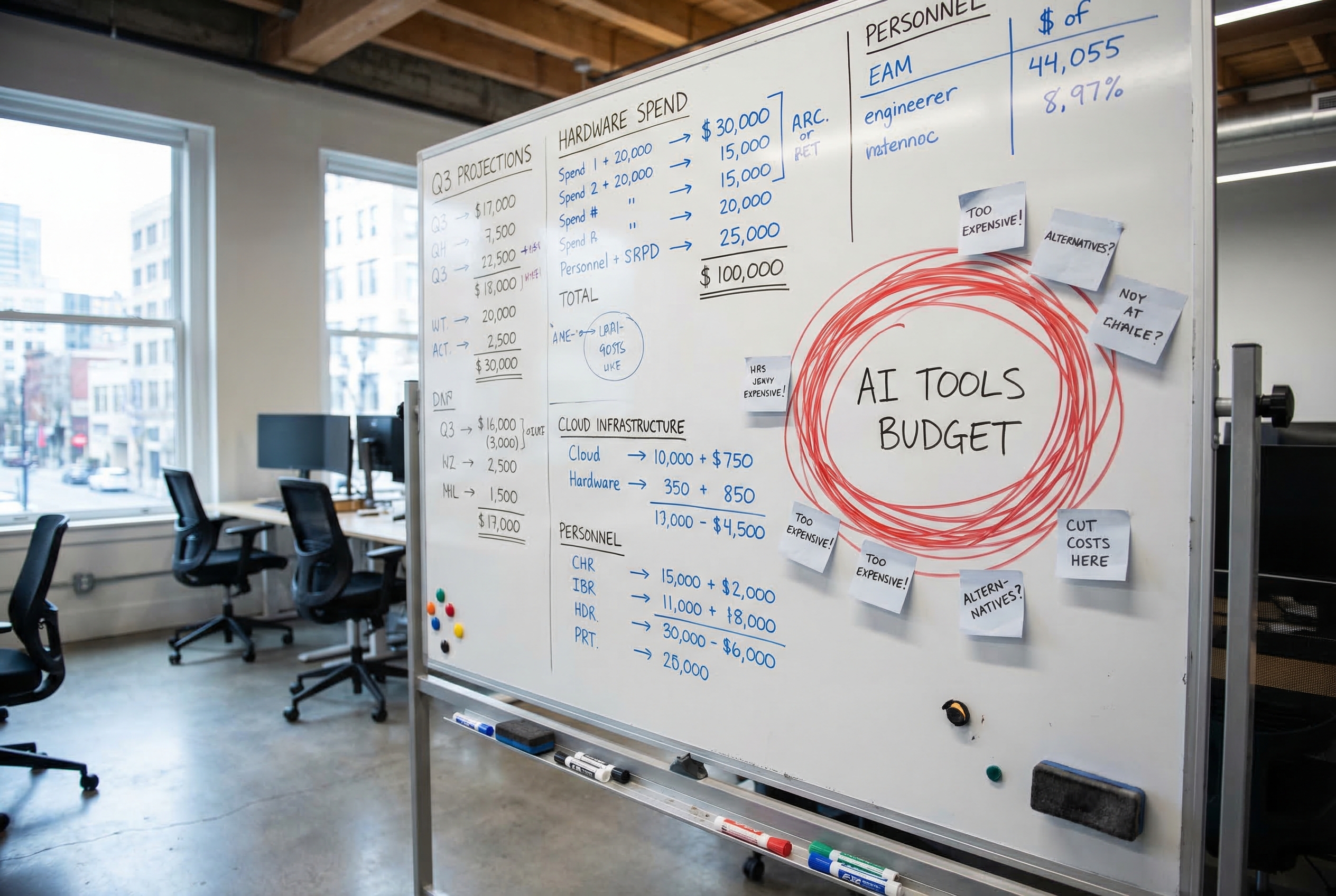
The pricing models themselves are still immature. Cursor has changed its credit structure multiple times. OpenAI adjusts API pricing quarterly. Anthropic's Claude Code pricing has different tiers that interact in non-obvious ways with the API costs underneath.
For engineering leaders trying to forecast costs, this is genuinely difficult. You can't commit to annual contracts with confidence when the vendor might restructure pricing mid-year, or when a model upgrade changes the token economics of every workflow your team has built.
Some teams are responding by consolidating on a single vendor to simplify forecasting. Others are building internal proxy layers that track and cap usage per developer. A few are experimenting with "AI budgets" per team, essentially treating inference costs like cloud compute, with dashboards, alerts, and spending limits.
All of these are workarounds. None of them solve the underlying problem, which is that the industry priced these tools for adoption and hasn't re-priced them for dependency.
What actually helps
Three things that engineering leaders doing this well have in common.
They track AI tool spend separately from traditional tooling, with its own line item, forecast model, and review cadence. Quarterly at minimum, monthly if usage is growing fast.
They benchmark cost per developer and cost per output rather than just total spend. A developer spending $400/month on AI tools but shipping 3x more code is a different conversation than a developer spending $400/month with no measurable output change.
They negotiate enterprise agreements early. Every AI coding tool vendor offers volume discounts and committed-use pricing that's meaningfully cheaper than pay-as-you-go. The teams waiting for "usage to stabilize" before negotiating are overpaying during the highest-growth period.
The new normal
AI coding tools went from "productivity experiment" to "significant line item" in about eighteen months. Most engineering organizations are still budgeting for the experiment phase while their developers are deep into dependency.
This isn't a crisis. The productivity gains are real and, for most teams, they justify the cost. But "it's worth it" and "we've budgeted for it" are two different statements. The gap between those two things is where surprises live.
The vendors will eventually mature their pricing. Usage-based models will get more predictable tiers. Enterprise agreements will standardize. But that stabilization is probably twelve to eighteen months away. In the meantime, the teams that treat AI tool spend as a real infrastructure cost, tracked, forecasted, and managed, will avoid the unpleasant quarterly surprise that's coming for everyone else.
Marco Kotrotsos writes about practical AI implementation at gloss.run and acdigest.substack.com.
Treat AI coding spend like cloud usage, not a fixed per-seat tool: track tokens/credits by team and workflow, set budgets and alerts, and forecast costs based on expected agent session volume. Audit which tools overlap (Cursor, Claude Code, Windsurf, Copilot) and consolidate where possible to avoid stacked bills. Before enabling large-context or always-on agents broadly, run a pilot to measure real token burn and negotiate pricing that matches how your developers actually work.