- Radiology wasn’t wiped out by AI because scan classification is only one task inside a larger, interdependent job bundle.
- The better question isn’t “what percent of tasks can AI do,” but “how much value is lost when tasks are unbundled and done separately.”
- Whether AI replaces part of a job depends on coordination costs: high costs keep the bundle intact (AI as a tool), low costs let tasks split off (humans lose associated revenue).
- Bundles stay strong when tasks share context, require non-transferable liability/accountability, and create cross-task learning spillovers that build expert judgment over time.
- Task-level automation can quietly degrade long-run quality by removing the “easy” work that trains people and feeds expertise for the harder work.
In 2016, Geoffrey Hinton said medical schools should stop training radiologists because AI would soon outperform them at reading scans. He was measuring one task: classifying images into diagnostic buckets. On that specific task, he was directionally right. AI got very good at pattern recognition in medical imaging.
Radiologists are still here. Still training. Still employed. Their income hasn't collapsed.
The reason is that reading a scan is only part of the job, and that part is entangled with everything else a radiologist does. They triage cases, communicate with referring physicians, train residents, take accountability for diagnostic calls that other clinicians will act on. What the market buys isn't a classification exercise. It's the bundle of all of these things together.
The framework that changes the conversation
A paper by economists at LSE and the University of Hong Kong, "Weak Bundle, Strong Bundle," reframes the AI jobs question. Instead of asking "how much of your job can AI do," it asks "how much value is destroyed when your job's tasks are done separately."
Most AI jobs studies count automatable tasks and produce heat maps. McKinsey says 30% of work hours could be automated. Goldman says 300 million jobs affected. They all assume automating a task means automating that share of the job.
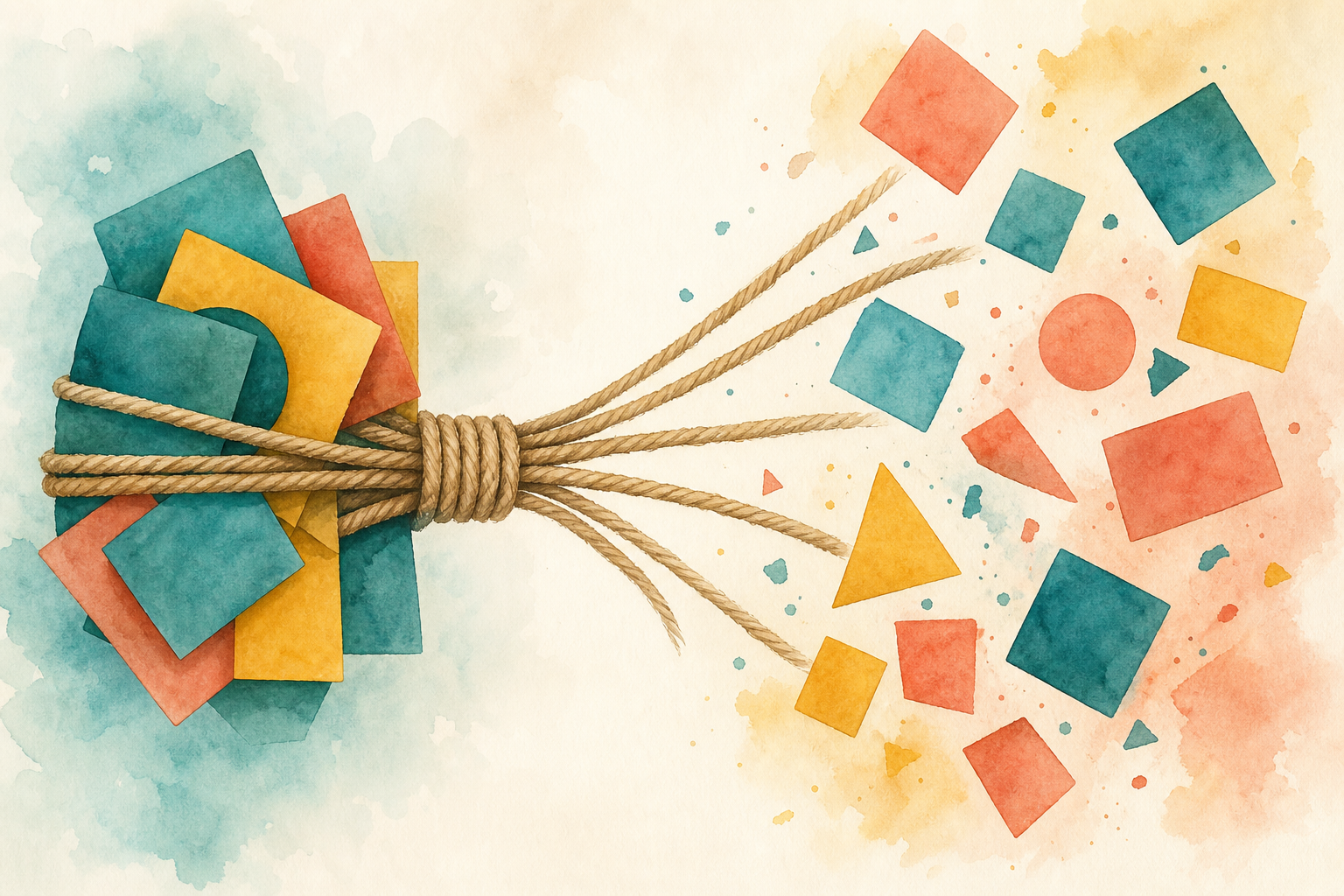
The paper argues this gets the unit of analysis wrong. The right question isn't "can AI do this task" but "what happens when you separate this task from the other tasks it's bundled with." When AI can perform one task inside a job, what happens next depends on the coordination cost of splitting that task away from everything it's connected to.
High coordination cost: the bundle survives. The human keeps all tasks and all revenue. AI becomes a tool the human uses to do their existing job better.
Low coordination cost: the bundle splits. The automated task gets separated. The human keeps the residual tasks but loses the revenue attached to the automated ones.
Three things that hold a bundle together
Shared context. The same person who read the scan also talked to the referring physician. Separate those tasks and the physician loses the contextual conversation that makes the result actionable. I see this constantly in AI deployments. A support team automates the easy tickets. Resolution time drops. But agents handling complex tickets lose the pattern recognition they built from handling easy ones first. Overall quality goes down. The tasks were entangled in ways nobody mapped.
Liability. The person who signs the diagnosis can't outsource the judgment because they can't outsource the consequences. When a radiologist puts their name on a report, they're accepting legal and professional accountability for everything in it. You can automate the pattern detection. You can't automate the signature. This applies everywhere someone is personally accountable: lawyers signing opinions, engineers stamping designs, doctors prescribing treatment, financial advisors making recommendations. The task can be automated. The accountability can't.
Cross-task spillovers. This is the most interesting one. What you learn doing one task makes you better at the other. A radiologist who reads thousands of scans develops intuitions that make them better at training residents, better at catching edge cases. Pull the scan-reading away and the radiologist doesn't just lose that task. They lose the learning that came from doing it. Over time, judgment on the remaining tasks degrades because they're no longer building expertise from the full scope of the work. This is the long-term risk no task-level automation study captures. Splitting a bundle doesn't just redistribute tasks. It can erode the capabilities that made the remaining tasks valuable.
Weak versus strong
A weak bundle: an AI meeting note-taker. Documenting who said what splits cleanly from the act of being in the meeting. Low shared context, low coordination cost. Automate it.
A strong bundle: the project manager in that same meeting who notices the engineering lead said "sure, we can try that" in a tone that means "this will fail and I'm not going to fight about it." Who takes the engineer out for coffee and gets the real objection on the table. Who prevents the project from derailing two months later because of an unspoken disagreement.
Same meeting. Same room. One task is a weak bundle. The other is a strong bundle. AI handles the first. The second requires everything the first study would miss.
The test you should run
Take any AI tool your team is evaluating. Ask: does this replace a task that splits cleanly from other tasks, or does it replace a task entangled with others through shared context, liability, or learning spillovers?
If it splits cleanly (note-taking, scheduling, first-draft generation, data entry), the automation works and the bundle weakens. Plan for the redistribution and the narrowing of the role it came from.
If it's entangled (diagnostic judgment, relationship management, accountability-bearing decisions, work that builds expertise used elsewhere), the bundle is strong. The AI becomes a tool, not a replacement. Invest in making the human better at the bundle, not in separating it.
Most roles contain both. The skill is in knowing which tasks are which.
When you evaluate AI’s impact on your role, map your work as a bundle: which tasks depend on shared context, which ones you’re personally accountable for, and which ones build the learning that makes you good at the rest. Push to use AI in ways that strengthen the bundle—speeding up routine steps while keeping you in the loop for judgment, communication, and sign-off—rather than letting high-value tasks get cleanly carved out. Pay special attention to “training tasks” (the easy reps), because losing them can erode your expertise and your team’s quality over time.