- Eli Lilly has launched LillyPod, a 1,016–GPU NVIDIA DGX SuperPOD system delivering over 9,000 petaflops, signaling a serious shift to AI-at-scale in drug discovery.
- Lilly and NVIDIA are backing the effort with a five-year, $1B co-innovation lab, framing compute and pharma know-how as a long-term competitive partnership rather than a pilot project.
- The core promise is timeline compression: using brute-force computation to move from 10–15 years to a targeted 5–7 years by testing vastly more hypotheses and improving molecule selection before clinical trials.
- LillyPod targets three major bottlenecks—protein diffusion models, small-molecule graph neural networks, and genomics foundation models—each aimed at reducing lab work and increasing early-stage hit rates.
- The broader implication is that pharma’s competitive moat is shifting toward computational infrastructure, data scale (e.g., 700 TB genomics), and AI talent, not just wet-lab expertise and trial networks.
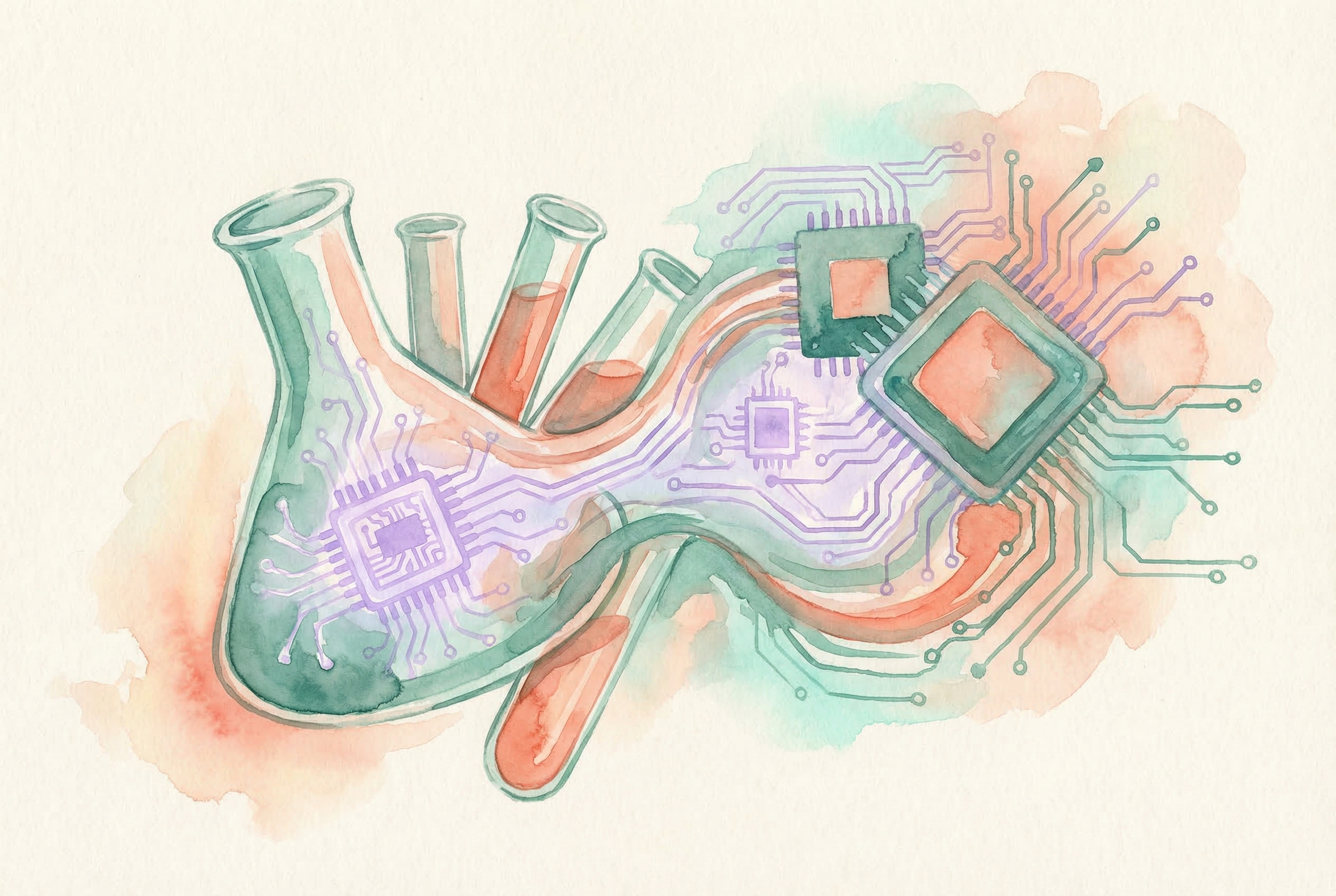
On February 27, Eli Lilly flipped the switch on LillyPod, the pharmaceutical industry's most powerful AI supercomputer. Built on NVIDIA's DGX SuperPOD architecture with 1,016 Blackwell Ultra GPUs, it delivers over 9,000 petaflops of AI performance. It was assembled in four months. And it represents a fundamental bet: that computational brute force can compress the decade-long drug development timeline into something dramatically shorter.
This isn't a research experiment. Lilly and NVIDIA announced a five-year, $1 billion co-innovation lab to pair this infrastructure with pharmaceutical expertise. The investment is real, the hardware is running, and the question is no longer whether pharma will use AI at scale. It's whether the scale matches the problem.
The numbers behind the bet
Drug discovery is one of the most expensive, failure-prone processes in any industry. The statistics haven't improved in decades.
| Metric | Traditional Drug Development | What LillyPod Promises |
|---|---|---|
| Average time to market | 10-15 years | Target: 5-7 years |
| Average cost per approved drug | $2.6 billion | Significantly reduced (TBD) |
| Clinical trial success rate | ~12% from Phase I to approval | Higher hit rate through better molecule selection |
| Molecular hypotheses tested per target per year | ~2,000 (wet lab) | Billions (computational simulation) |
| Protein structure prediction time | Weeks to months | Hours to days |
| Genomic data capacity | Limited by compute | 700 TB across 290 TB of GPU memory |
The gap between 2,000 wet-lab hypotheses per year and billions of computational hypotheses is not incremental improvement. It's a different category of search. LillyPod's genomics team can now harness 700 terabytes of data, the kind of scale that makes it possible to find patterns across entire genomes rather than studying individual pathways in isolation.
What it actually does
LillyPod supports three primary AI workloads, each targeting a different bottleneck in the drug development pipeline.
Protein diffusion models
Understanding how proteins fold, bind, and interact is fundamental to drug design. Traditional methods like X-ray crystallography take months per structure. AI models, building on the approach pioneered by AlphaFold, can now predict protein structures in hours. With 1,016 GPUs training custom diffusion models, Lilly can explore how proteins behave under different conditions at a scale that was computationally impossible before.
Small-molecule graph neural networks
Finding a molecule that binds to the right target without causing harmful side effects is the core challenge of drug design. Graph neural networks model molecules as mathematical structures, predicting their properties before they're ever synthesized. Instead of making thousands of compounds in a lab and testing each one, you simulate millions computationally and only synthesize the most promising candidates.
Genomics foundation models
This is where the long-term bet gets interesting. Foundation models for genomics work the same way language models work for text, they learn the underlying patterns and structure of genetic data, enabling them to make predictions about gene function, disease mechanisms, and drug targets that weren't explicitly part of their training data. With 700 TB of genomic data, Lilly is training models that could identify entirely new therapeutic targets.
Why this matters beyond Lilly
LillyPod is the most visible example, but it represents a broader trend: pharmaceutical companies are becoming compute companies. The competitive moat in drug development is shifting from wet-lab expertise and clinical trial networks toward computational infrastructure and AI talent.
| Company | AI Investment Signal | Scale |
|---|---|---|
| Eli Lilly | LillyPod + $1B NVIDIA partnership | 1,016 Blackwell GPUs, 5-year commitment |
| Recursion Pharmaceuticals | BioHive-2 supercomputer | Among top 500 most powerful computers globally |
| Insilico Medicine | AI-designed drug in Phase II clinical trials | First fully AI-discovered drug candidate |
| Isomorphic Labs (DeepMind) | AlphaFold-based drug discovery | Partnership with Lilly and Novartis |
| Absci | Generative AI for antibody design | De novo antibody generation from text prompts |
The pattern is consistent. Every major pharmaceutical company is either building or buying its way into AI-driven drug discovery. The ones that don't are making a bet that traditional methods will remain competitive against organizations that can test billions of hypotheses where they can test thousands.
The hard part nobody mentions
There's a reason drug development takes a decade, and most of that reason has nothing to do with computational limitations.
Clinical trials require actual humans taking actual drugs over actual time. You can't simulate a five-year cardiovascular outcome study. You can't computationally model the infinite complexity of a drug interacting with an entire human body over months and years. Side effects that emerge at year three of treatment don't care how many GPUs you used to design the molecule.
LillyPod accelerates the front end of the pipeline: target identification, molecule design, and candidate selection. That's valuable. Picking better candidates means fewer failures in expensive clinical trials. But the clinical trials themselves still take years, still require regulatory approval, and still face the irreducible complexity of human biology.
The honest framing is that AI supercomputers make the first three years of a ten-year process dramatically faster and more productive. They don't make the last seven years shorter. A drug that enters Phase I clinical trials in 2026 instead of 2029 still needs five to seven years of clinical data before approval. The acceleration is real, but the compression of the total timeline is more modest than the headlines suggest.
The sustainability question
LillyPod runs on 1,016 GPUs drawing enormous power. Lilly has committed to running on 100% renewable electricity by 2030, supported by liquid cooling that reduces energy waste. That's four years from now.
In the meantime, pharmaceutical AI joins the growing list of industries where the environmental cost of AI is absorbed today while the sustainability promises are dated for tomorrow. Whether the therapeutic breakthroughs justify the energy expenditure is a legitimate question, especially as more pharma companies build similar infrastructure.
What to watch
The real test of LillyPod isn't whether it can process genomic data faster. It's whether the drugs that emerge from AI-accelerated discovery pipelines actually perform better in clinical trials. If AI-selected candidates have a 20% success rate in Phase I instead of the historical 12%, the ROI is obvious. If the success rate doesn't improve, then what Lilly has built is a very expensive way to fail faster.
The first AI-accelerated drug candidates from this generation of compute infrastructure should enter clinical trials within two years. That's when we'll know whether pharma's billion-dollar GPU bet was prescience or expensive optimism.
If you work in biotech, pharma, or investing, watch for whether these GPU-scale platforms translate into measurable outputs—more validated targets, better preclinical candidates, and higher Phase I/II success rates—rather than just faster model training. Pay attention to which companies can pair massive compute with proprietary data and strong experimental validation loops, because that combination is likely to determine who actually shortens timelines and lowers costs. For technical teams, the signal is clear: skills in diffusion models, GNN-based chemistry, and genomics foundation modeling are becoming directly tied to drug pipeline competitiveness.