- Apple says its rebuilt, LLM-powered Siri will ship with iOS 26.4 in spring 2026, roughly two years after Apple Intelligence was announced.
- The upgrade replaces Siri’s legacy intent-based system with an LLM that can use personal data, understand on-screen context, and take cross-app actions via App Intents.
- While the new Siri is a major architectural shift, it arrives after rivals (ChatGPT, Claude, Gemini) have already set higher expectations with rapid iteration, long context, memory, and agentic workflows.
- Apple’s strongest differentiators are deep OS-level integration and a privacy posture anchored by on-device processing plus Private Cloud Compute.
- The risk is that “working” won’t be enough in a market where the definition of “excellent” advances monthly, making baseline parity feel like table stakes.
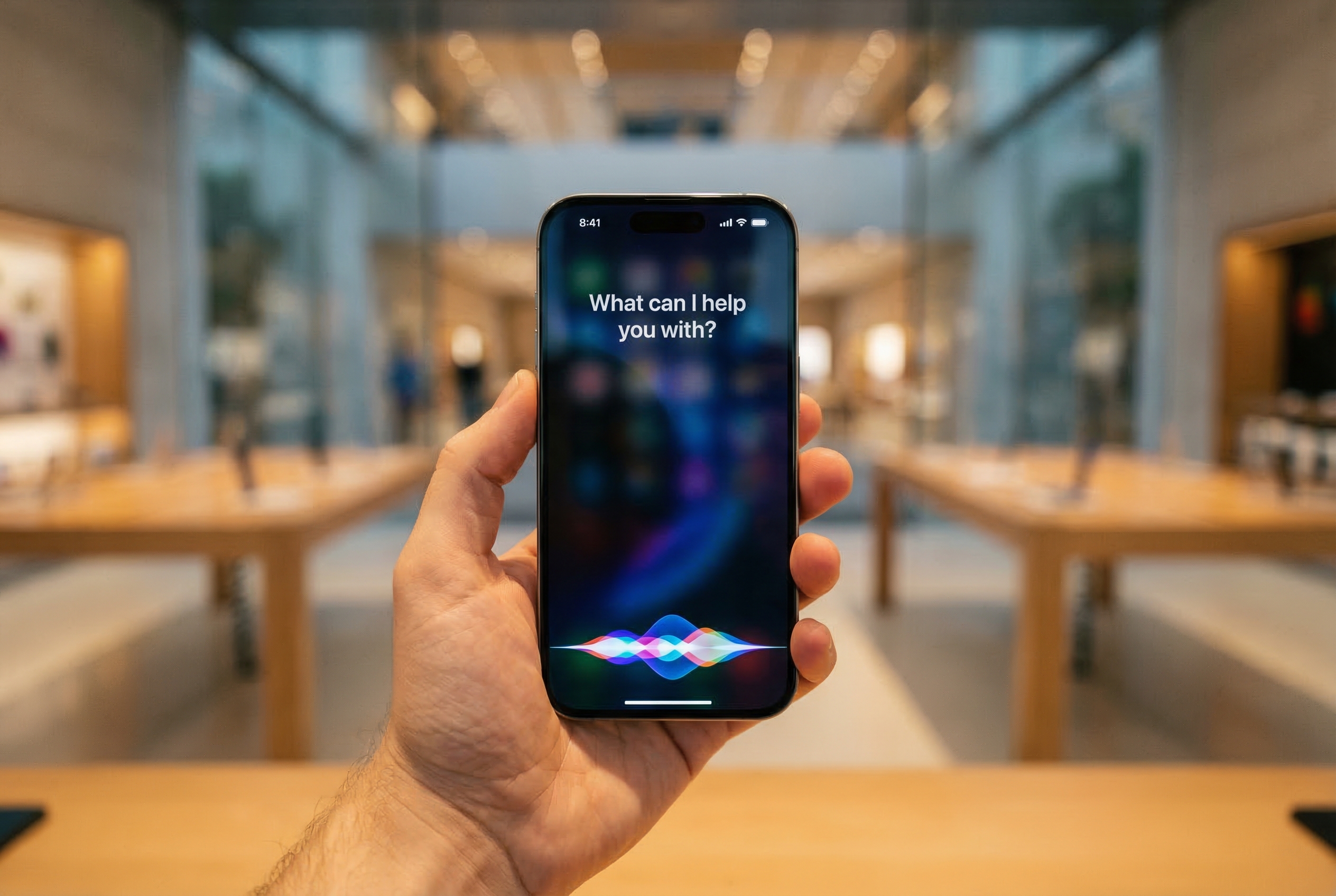
Apple has confirmed that its reimagined, LLM-powered Siri will finally debut with iOS 26.4 in spring 2026. The upgrade replaces Siri's years-old architecture with a large language model foundation, adds the ability to understand personal data and on-screen context, and introduces agent-like capabilities for taking actions across apps.
It's a genuine transformation. It's also arriving in a world where ChatGPT, Claude, and Gemini have been doing all of that for over a year. The competitive bar moved while Apple was building, and the question is no longer whether the new Siri works. It's whether "works" is enough when the market has already defined "excellent."
The timeline tells the story
The delay reveals how much Apple underestimated the engineering challenge of rebuilding Siri from the ground up.
| Date | Event |
|---|---|
| June 2024 | Apple announces "Apple Intelligence" at WWDC |
| Fall 2024 | Initial Apple Intelligence features ship, Siri LLM upgrade planned for 2025 |
| Early 2025 | Internal delays, Siri overhaul pushed back |
| June 2025 | Bloomberg reports Siri upgrade targeting spring 2026 |
| Feb 2026 | Apple confirms Siri LLM launch with iOS 26.4 |
| Spring 2026 | Expected release |
Two years from announcement to delivery. In that time, OpenAI went from GPT-4 to GPT-5.4 with a million-token context window. Anthropic shipped Claude with persistent memory. Google integrated Gemini across Workspace, Search, and Android. The entire competitive landscape transformed while Apple was replacing plumbing.
What new Siri actually brings
To be fair, what Apple is building is genuinely ambitious. The new Siri isn't just a chatbot bolted onto iOS. It's a system-level AI assistant with deep operating system integration.
| Capability | Old Siri | New Siri (iOS 26.4) |
|---|---|---|
| Language understanding | Intent classification (rigid) | LLM-based natural language (flexible) |
| Personal context | Limited to contacts, calendar | Access to emails, files, on-screen content |
| App actions | Pre-built integrations only | Cross-app actions via App Intents framework |
| Conversation | Single-turn commands | Multi-turn context retention |
| On-screen awareness | None | Understands what's displayed on screen |
| Privacy model | On-device where possible | On-device + Private Cloud Compute |
The on-device integration is Apple's genuine differentiator. ChatGPT and Claude can draft an email, but they can't read what's on your screen, pull a phone number from your message thread, cross-reference it with your calendar, and suggest rescheduling a meeting. Siri, with system-level access, theoretically can.
The privacy architecture is the other advantage. Apple's Private Cloud Compute model processes AI requests in a way that even Apple can't access the data. In a post-QuitGPT world where users are increasingly sensitive to how AI companies handle their information, that's not just a feature. It's a market position.

The problem with late
Being late with a superior product has worked for Apple before. The iPhone wasn't the first smartphone. The Apple Watch wasn't the first smartwatch. Apple's playbook is to wait, refine, and ship something better than what exists.
The problem with AI assistants is that the "better" bar moves monthly, not yearly.
| What "Good" Looked Like | When |
|---|---|
| Answer factual questions accurately | 2023 |
| Summarize long documents | 2023 |
| Write and edit text competently | 2024 |
| Multi-turn reasoning conversations | 2024 |
| Execute multi-step agentic workflows | 2025 |
| Persistent memory across sessions | 2026 |
| Real-time tool use and web interaction | 2026 |
By the time Siri launches, the baseline expectation for an AI assistant will include everything on this list. Matching the baseline isn't impressive, it's table stakes. Apple needs to exceed it, and the areas where it can, system integration and privacy, are features that are hard to demo and slow to appreciate.
The Google dependency
Perhaps the most surprising revelation is that Apple's next-generation foundation models will be partly based on Gemini and Google's cloud technologies. This is the company that built custom silicon to avoid depending on Qualcomm, that created its own maps to avoid depending on Google, that designed its own search technology to reduce reliance on Google Search.
And for the most consequential technology transition of the decade, it's partnering with Google.
The pragmatism is understandable. Training frontier models requires infrastructure that Apple doesn't have at the necessary scale. Google has both the models and the cloud capacity. But the dependency introduces a vulnerability: Apple's AI capabilities are partly gated by a competitor's technology roadmap.
What to watch
The real test of new Siri isn't launch day. It's day 90. The initial reviews will focus on what Siri can do: answer questions, summarize messages, take actions across apps. The meaningful evaluation happens when millions of users start using it daily and discover the edges.
How does it handle ambiguous requests? How well does it understand context that spans apps and conversations? How reliably does it execute multi-step actions without making mistakes? How does it degrade when the network is slow or unavailable?
These questions can't be answered by a keynote demo. They get answered by usage, and usage reveals truth that no benchmark captures.
Apple has a window. The new Siri launches into a market where users are frustrated with the limitations of cloud-based AI assistants and increasingly concerned about privacy. If Apple executes, the on-device integration and privacy model could make Siri the AI assistant people actually trust with their personal data. If it ships with the usual v1 rough edges and "it'll get better in future updates" caveats, it becomes another example of Apple arriving late to a party that already moved venues.
The architecture is right. The timing is wrong. The question is whether the architecture is good enough to overcome the timing.
If you’re deciding whether to wait for Apple’s new Siri, watch for two things in the iOS 26.4 rollout: how reliably it can take real actions across apps (not just chat) and how much of that happens on-device or through Private Cloud Compute. In the meantime, assume third-party assistants will keep improving faster, so pick tools based on what you need now—speed and breadth of capabilities versus tighter device integration and stronger privacy guarantees. As spring 2026 approaches, pay attention to real-world demos and reviews that test on-screen awareness, personal context access, and multi-step workflows under everyday conditions.