- A small Atlantic City bakery replaced a $1,800/month freelance designer with a ~$47/month set of AI tools, shifting design work in-house with “good enough” results customers didn’t notice.
- The bakery’s needs (social posts, menu updates, flyers, logo vectorization) were routine production tasks that AI-assisted tools can now handle cheaply and quickly.
- A low-cost stack (Canva Pro, Ideogram, VectoSolve, Remove.bg, ChatGPT Plus) covered most design workflows end-to-end, from photo cleanup to typography-heavy promos to vector conversions.
- The owner spent about two extra hours per week doing the work herself but saved roughly $1,753 per month—material savings for a small business operating on tight margins.
- Per-task comparisons suggest AI tools can cut common design costs by close to 99%, signaling that the old freelancer cost structure for basic design work is rapidly collapsing.
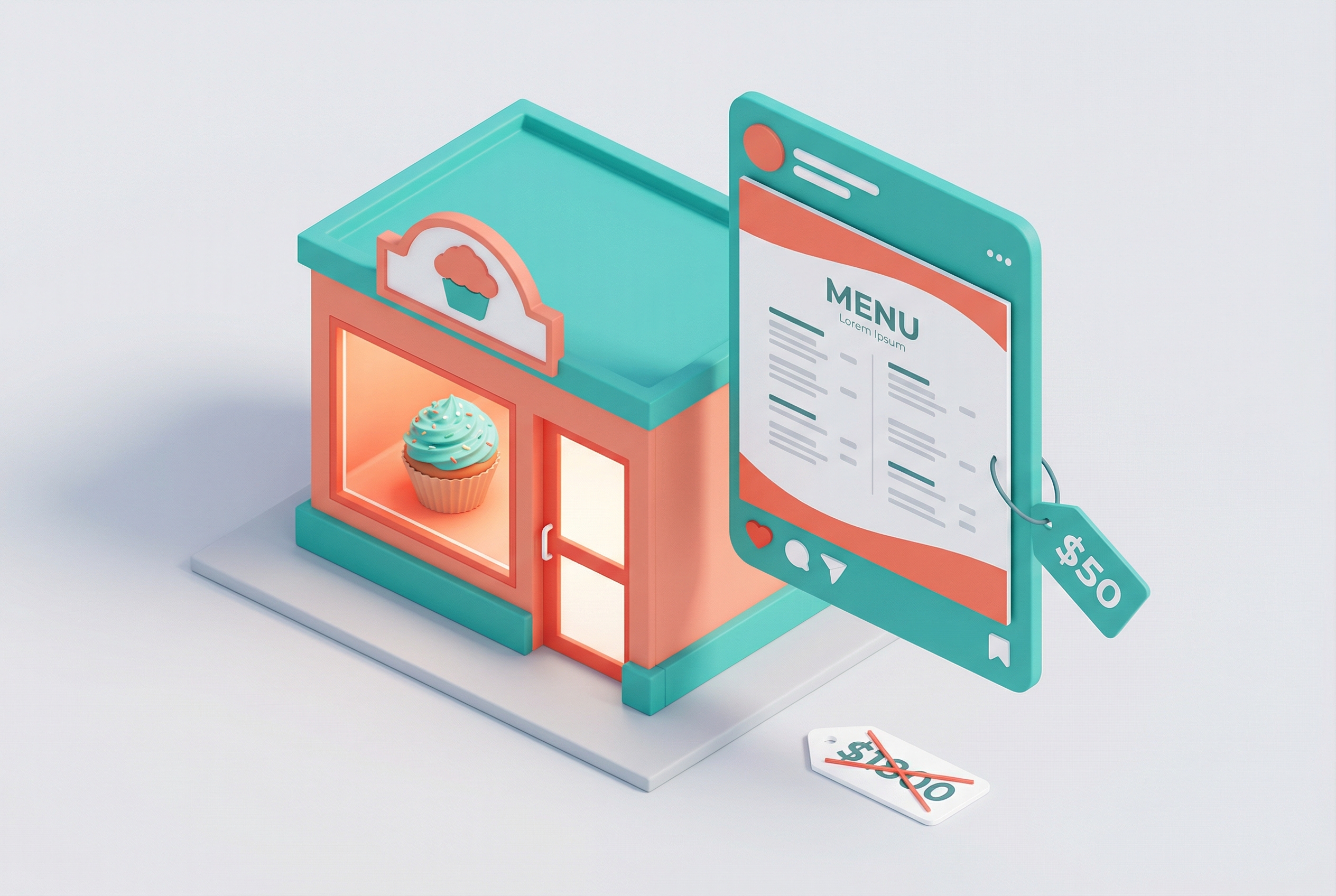
Last January, a bakery in Atlantic City was paying a freelance designer $1,800 a month. Social media graphics, seasonal menu updates, logo vectorization for merchandise. Standard small business stuff. The designer was good. The work was consistent. The invoice was painful.
By February, that line item read $47.
Not because they found a cheaper designer. Because they stopped needing one. The owner stitched together a stack of AI tools, most of them free or nearly free, and started doing the design work herself. The quality, by her own admission, isn't always identical. But it's close enough that her customers haven't noticed, and her bank account definitely has.
She's not the exception anymore. She's the new normal.
What $1,800 a month actually bought
The bakery's design needs were typical for a small food business. Ten to fifteen social media posts per month, mostly product shots with branded overlays. Menu redesigns whenever the seasonal offerings changed, roughly quarterly. Logo vectorization for boxes, bags, and the occasional promotional item. A flyer here and there for local events.
None of this required a design genius. It required someone competent with Adobe Illustrator, a decent eye for layout, and the patience to iterate on feedback. The freelancer delivered all of that. The problem was purely economic: $1,800 per month adds up to $21,600 per year. For a bakery doing maybe $400K in annual revenue, that's not a rounding error.
The owner didn't wake up one morning and decide to fire her designer. She saw a TikTok of another small business owner generating Instagram posts with Canva's AI tools and thought, "I should try that." Three weeks later, the freelancer was gone.
The $47 stack
Here's what replaced an $1,800/month professional:
| Tool | What it does | Monthly cost |
|---|---|---|
| Canva Pro | Social media templates, brand kit, AI image generation | $13 |
| Ideogram | Typography-heavy graphics, poster designs | $8 |
| VectoSolve | Logo vectorization, image upscaling | ~$2 (pay-per-use) |
| Remove.bg | Background removal for product photos | Free tier + ~$4 |
| ChatGPT Plus | Copy for posts, caption ideas, layout suggestions | $20 |
| Total | $47 |
The workflow looks something like this: she takes product photos on her phone, removes backgrounds with Remove.bg, drops them into Canva templates she's customized with her brand colors and fonts, and publishes directly to Instagram and Facebook. For more complex pieces, like event flyers or seasonal promotions, she uses Ideogram to generate typography-forward designs, then tweaks them in Canva. When she needs her logo in a new format or size, VectoSolve handles the conversion for pennies.
The whole process takes her about four hours a week. She used to spend two hours a week briefing the designer, reviewing proofs, and requesting changes. So the net time increase is roughly two hours, but she's saving $1,753 a month. At her bakery's margins, that's real money.
The old cost structure is collapsing
This bakery is one data point. The trend is everywhere.
A cost analysis from VectoSolve breaks down the per-task numbers, and they're hard to argue with:
| Design task | Traditional cost | AI tool cost |
|---|---|---|
| Logo vectorization | $75-200 | $0.20 |
| 10 social media graphics | $500-800 | $2-5 |
| Background removal (20 images) | $100-200 | $1.40 |
| Menu or flyer design | $150-300 | $2-5 |
| Product photo cleanup | $200-500 | $3-5 |
| Monthly total | $1,025-2,000 | $9-16 |
That's not an 80% reduction. That's closer to 99% on individual tasks. The reason the bakery's total hit $47 instead of $9 is that she's paying for Canva Pro and ChatGPT Plus as subscription tools she uses for more than just design.
Ramp, the corporate card company, published a study tracking how businesses shifted spending from freelancer platforms to AI tools between 2021 and 2025. The findings were blunt: companies that spent the most on freelancers before ChatGPT launched substituted at a rate of roughly $1 in AI spending for every $33 in reduced freelance spending. More than half the businesses that were buying from freelance marketplaces in 2022 had stopped entirely by 2025.
The broader pattern
The bakery's story fits into a larger dataset. Business.com's 2026 Small Business AI Outlook Report surveyed over 1,000 employees at companies with 2 to 250 people. The headline numbers:
- Small business workers save an average of 5.6 hours per week using AI tools
- Managers report saving 7.2 hours weekly, individual contributors about 3.4
- 57% of U.S. small businesses are now investing in AI technology, up from 36% in 2023
- 30% of employees use AI at least once daily
- 61% report increased AI usage compared to the previous year
The 5.6 hours figure roughly matches what the bakery owner described. She's spending four hours on design that used to be outsourced, but she's saving time on other tasks too, using ChatGPT for customer email responses, social media captions, and even basic bookkeeping categorization. The net effect is she's working fewer hours than before, not more.
What this means for freelance designers
I want to be honest about this part, because the human cost is real.
The freelancer who lost the bakery account is a real person who lost $1,800 in monthly recurring revenue. Multiply that across thousands of small businesses making similar calculations, and you get a profession under genuine pressure.
The Ramp data tells the story in spending patterns: the share of total business spend going to freelance labor marketplaces dropped from 0.66% in late 2021 to 0.14% by mid-2025. That's not a dip. That's a structural collapse in one spending category.
Freelance designers who survive this shift are the ones doing work that AI genuinely can't replicate yet: brand strategy, complex identity systems, packaging design that has to work in physical space, illustration with a distinctive style. The commodity layer of design, the social media templates and menu updates and basic vectorization, is where AI eats first. And for a bakery in Atlantic City, that commodity layer was 100% of what they were buying.
The quality question
If you put the freelancer's work and the AI output side by side, a trained designer would pick out the differences. The freelancer's work is more polished. The spacing is tighter. The color choices are more intentional.
None of that matters if the Instagram post gets the same number of likes. A seasonal menu that looks 85% as polished, posted the same day the new items launch instead of three days later because the designer had other clients, is more valuable to the bakery than a perfect menu that arrives late.
Small businesses have always made this tradeoff. They used to make it by choosing between a $5,000/month agency and an $1,800/month freelancer. Now they're choosing between the freelancer and a $50 AI stack. The threshold for "good enough" keeps rising as the tools improve, and the price keeps falling.
Canva's AI features have gotten noticeably better even in the last six months. Ideogram can render text inside images with roughly 90% accuracy, something that was basically impossible for AI image generators two years ago. The tools aren't standing still.
What I'd tell a small business owner
If you're spending more than $500 a month on routine design work, social media graphics, menu updates, basic print materials, you should at minimum test what the current AI tools can do. Not to fire anyone immediately, but to understand where the floor is.
Start with Canva Pro. Upload your logo, set your brand colors and fonts, and try generating a week's worth of social posts. It takes about an hour to learn the basics. If the output is 80% of what you're getting from your designer, you have a decision to make.
The bakery owner in Atlantic City didn't set out to eliminate a role. She set out to save money during a slow January, tried a tool she saw on social media, and realized the gap between professional design and AI-assisted design had closed to a point where the price difference couldn't be justified.
That calculation is going to keep getting easier. Canva and Ideogram release meaningful updates almost monthly. Prices haven't gone up. And what people consider "good enough" keeps shifting as they see more AI-generated work in the wild and stop being able to tell the difference.
For the bakery, $1,753 in monthly savings buys a new oven. Or a part-time counter employee for the summer. Or just the breathing room to survive a slow February without dipping into savings.
If you’re paying for routine design work, audit what you actually need (social templates, background removal, simple flyers, vector files) and test an AI-first workflow for a month before committing to another retainer. Start with a brand kit in a template tool, use background removal and vectorization services for the repetitive tasks, and lean on a text assistant for captions and layout ideas. The trade-off to watch is time: you may spend a couple more hours a week, but the savings can be significant if your work is mostly production-level design.